Read this article with AI
Copy the article text into your chosen tool to inspect its sources and trade-offs.
Read each result as a specific observation
A network address, geolocation estimate, browser value and account association are different kinds of evidence. Ask where the result came from and when it was observed. A test page’s label may combine a vendor database lookup with measurements from the current request.
| Test output | What it may describe | What it does not certify |
|---|---|---|
| IP address | Address visible at that observation point | Every address visible to every service |
| Proxy or VPN label | Provider-specific network classification | User intent or guaranteed privacy |
| Location estimate | Location associated with an input | Exact physical whereabouts |
| Browser fingerprint | Characteristics or an environment association | A universal personal identifier |
| “Risk” score | The test provider’s model output | A common industry-wide probability |
Keep unavailable fields visible. A test that cannot collect a signal has learned less, not established that the environment is safe or anonymous.
Separate IP privacy from account identity
A privacy service can change the network address a site sees while a visitor remains logged into an account. An application can then associate the visit through that account without needing to infer identity from the network.
Apple’s Private Relay documentation explains its network behavior and location-related context. That product-specific description should not be expanded into a claim that all traffic from all applications is anonymous.
Read cookieless visitor identification for the distinction between accounts, people and browser environments. Read proxy detection APIs for how a server determines the relevant client-address input.
Understand the fingerprinting boundary
Browsers can expose characteristics useful for distinguishing or associating environments. The W3C fingerprinting guidance discusses the privacy implications and mitigations. A test result is affected by what the browser exposes and what the test actually measures.
A changed value does not prove that every prior association has disappeared. A stable value also does not prove that only one person uses the environment. Avoid turning a single hash into a broad privacy verdict.
The audio fingerprinting article explains one measurement family, including why an offline audio computation differs from microphone recording.
Compare tests under controlled conditions
Use an authorized browser and record the test service, time, browser version and relevant network context. Compare the same output definition rather than two differently named “anonymity scores.”
A hypothetical quality check runs the same page from a normal office connection and an approved privacy service. The useful finding is which observed fields changed, remained stable or were unavailable. It is not proof that an unrelated website must produce the same verdict.
Do not provide passwords or private documents to a test that only needs to inspect a request. Review what a service collects before using it in a customer or employee environment.
Use privacy-tool results fairly in fraud decisions
People use privacy networks for ordinary reasons. A VPN or relay classification can be context for an application decision without proving abuse. Keep eligibility, account authority and confirmed harmful behavior separate.
If your business uses a test service to assess its own integration, evaluate false alarms and missing results alongside the detected labels. VPN and proxy detection tools covers procurement questions and legitimate privacy-tool use.
State the conclusion narrowly
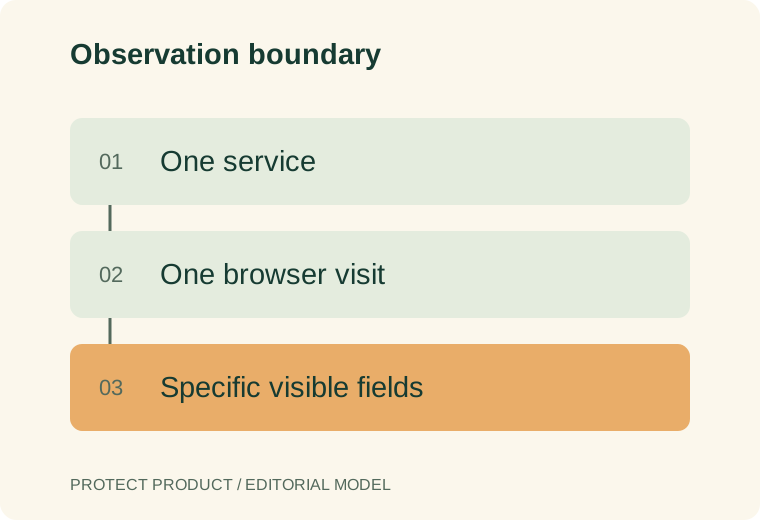
A useful report says what was observed, under which conditions and which questions remain open. “This service saw this address and these browser fields” is testable. “Completely anonymous everywhere” is not supported by that evidence.
For privacy evaluation, combine relevant technical observations with the account, storage and data-sharing behavior of the services involved. For fraud evaluation, test the specific protected action. Neither task can be replaced by one decorative score.
FAQ
Can a test prove complete online anonymity?
No. It reports observations available to that service under the test conditions, not every possible association elsewhere.
Does using a VPN make a visitor fraudulent?
No. Privacy-network use and harmful behavior are different questions.
Why do two anonymity tests disagree?
They may use different inputs, databases, collection methods, timing and score definitions. Compare those details before comparing labels.
Sources
Editorial basis: primary-source documentation and a practical evaluation framework. Examples are hypothetical unless explicitly identified otherwise. This article does not report an independent vendor benchmark.
For evaluation standards and corrections, see our methodology and contact page.