Read this article with AI
Copy the article text into your chosen tool to inspect its sources and trade-offs.
Choose the comparison axis first
“Sardine competitors,” “Arkose alternatives” and “Sift versus Kount” can describe different buying tasks. A risk team may need transaction decisioning, an application team may need account defense and a developer may need a browser identity building block.
Keep the required event explicit. Compare payment authorization at checkout separately from detecting repeat signups or prioritizing a review queue. If a supplier offers several modules, ask which one is in the quote.
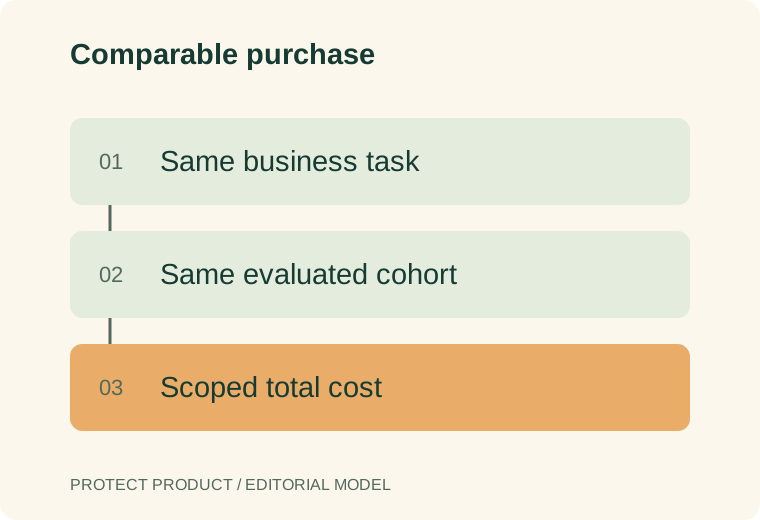
Compare fraud vendors by the decision, evidence and contract
Sift and Kount: compare the current product, not an old plan card
Sift Account Defense describes login intelligence, durable device context, post-login monitoring and session-level controls. Kount's public root currently leads to Equifax Identity & Fraud, which presents identity verification, orchestration and fraud-risk services. A useful comparison starts by naming the product and integration actually being quoted. A former Kount plan name is not a current contract.
For a merchant, ask both suppliers to walk through the same order and its preceding account activity. For a fintech flow, add the identity or transfer decision the business must make. Record what arrives in the response, what is retained for a reviewer, and which event triggers a billable check. Put chargeback responsibility in a separate commercial row. Device recognition, payment decisioning and reimbursement are valuable capabilities, but strength in one does not establish the others.
| Evaluation row | What to request from each supplier | Why the answer matters |
|---|---|---|
| Protected event | The named login, signup or payment integration | A product-family name can hide a missing event |
| Evidence returned | Reasons, identifiers, timestamps and action support | Reviewers need the actual response, not a slide |
| Commercial unit | Included event volume and additional charges | Orders and API checks can have different denominators |
| Financial responsibility | Written eligibility, exclusions and claim process | A score does not transfer a merchant's liability |
| Outcome feedback | How confirmed results reach the system | Evaluations need consistent, mature labels |
Wyllo and Signifyd extend beyond a checkout-only description
Wyllo, formerly NoFraud, presents payment protection, bot/reseller detection, return and policy-abuse prevention, CX support and chargeback management. Signifyd now describes pre-account device/bot context and account creation, login and modification alongside commerce protection. Treating either as nothing more than a checkout score would miss part of its current surface.
Ask how the proposed integration connects an account to orders, returns and support interactions. If a person changes an email address and then requests a refund, which events are evaluated and which explanation reaches the operator? If a guarantee matters to the purchase, request the precise covered decisions and exclusions in writing. A homepage promise should not be expanded into coverage of every return, policy dispute or payment method.
A hypothetical retailer comparing these products could use an approved order, a disputed order, a return request and a customer-support appeal as four separate cases. Keep the order facts constant while changing the event under review. This reveals where the workflow differs without manufacturing a head-to-head performance result.
Plaid Signal targets ACH return risk
Plaid Signal combines bank-account and transaction information for ACH risk decisions. Its page distinguishes balance checks from transaction-risk assessments, including administrative and insufficient-funds return risk. That is a more specific job than identifying a browser, and a different commercial responsibility from guaranteeing a card order.
For an ACH payment, document when the account was connected, when balance or risk information was read, and which transfer outcome will later label the decision. Compare another ACH tool against those same inputs and timing. A good browser-risk result can complement the account history, but it does not replace the bank-account evidence required for the transfer. Conversely, an ACH score should not be counted as protection for a free trial that never reaches a bank-payment flow.
Oscilar and Sardine: inspect the workflow you will operate
Oscilar and Sardine publish broader risk-platform capabilities. A buyer should compare the actual modules and operational workflow rather than decide that every product labeled AI fraud detection performs the same task. Map onboarding, account events, payment decisions and investigation responsibilities separately.
Ask who maintains the selected policies, how changes are reviewed, which data integrations are required and what a reviewer can export. Where the team needs a ready account-abuse result, include ShieldLabs in the relevant comparison: it combines visitor, user, device and IP context with risk scoring and ready Multi-accounting, Account sharing, Impossible travel and Account takeover detection. The useful distinction is the delivered workflow and its operating burden, not a contest of unqualified AI adjectives.
Define cross-device and cross-merchant identity before ranking it
Cross-device can mean linking authenticated activity to one account, recognizing a device, or estimating that different devices relate to the same person. Cross-merchant can mean using network-wide risk knowledge, returning a portable identifier, or giving a merchant access to another business's data. These are different promises.
Forter, Signifyd and Sift provide relevant identity/network capabilities to examine. Ask each supplier to describe the matching object, supported surfaces, permissions, false-match handling and the exact fields a customer receives. A large network is not permission to browse other merchants' customer records. If recognition across devices is the deciding requirement, put a supported example and an acceptable error-handling process into the procurement acceptance criteria.
Agent identity infrastructure and takeover detection have different roles
Microsoft Entra Agent ID concerns agent identities, access, governance and lifecycle controls. Auth0's AI identity offering addresses authentication and authorization around agent interactions. These products help define what an agent may access. An account-takeover detector asks a related but different question about the risk of activity using an account.
A hypothetical business assistant that can read an invoice should receive a narrowly scoped authorization. A later request to change the payout destination also needs the business's account and transaction protections. Do not count an identity-platform agent feature as a universal real-time takeover guarantee. Evaluate the identity control, the risk assessment and the protected action together.
Check the exact trial and tool category
FraudFilter advertises a seven-day no-card trial; its pricing page separately describes a fifteen-day refund policy. Those are different access conditions. AdPolice offers a Free Brand Check and a guided demo: a submitted brand analysis is not the same experience as opening a full self-serve product trial.
Fraudlogix separates IP-risk scoring, an IP blocklist and programmatic post-bid IVT analytics. Compare an alternative against the product layer you use. For device properties, DeviceAtlas is a different evaluation from persistent visitor identity or ready account-abuse events. For creator-audience vetting, HypeAuditor and Modash provide relevant influencer analytics; a signup-risk detector should not be presented as an audit of a creator's followers.
Use the public checker directory for the available inspection routes. Keep sales-guided access, a time-limited trial and an immediately usable checker distinct in your evaluation notes.
ShieldLabs account access, cancellation and company details
Use the official ShieldLabs console for account access, reached through the official product domain. Keep sign-in credentials and API secrets out of public support requests. A similarly named site is not the same service.
The published terms, section 5.3, say paid subscriptions renew unless cancelled before the renewal date; cancellation can be requested at any time and takes effect at the end of the current paid period. Use the account's current billing interface or the official contact route for account-specific assistance. The terms identify [email protected] as the contact email. The public contact page provides an email/form route rather than a verified support telephone number.
The legal documents identify ShieldLabs Inc at 30 N Gould St Ste R, Sheridan, WY 82801, USA. This is the published registered-company address; it should not be transformed into a claim about where every employee or server operates. For current product limits use the current pricing page, because a legal document's older retention wording and a live plan table can describe different versions.
This site's existing ShieldLabs offer uses SHIELDLABS19. Follow the displayed offer and check the actual terms presented during signup. A listed code is not a promise that every existing account qualifies or that the offer never changes.
What the individual ShieldLabs comparison pages help a buyer distinguish
The ShieldLabs comparison index presents twenty products through its own editorial scoring framework. It positions ShieldLabs around ready visitor, user, device and IP risk plus account-abuse detection. Read that published score as the output of that page's rubric; it should not be substituted for this site's preserved scores or for a measured result on your traffic.
The individual pages make the buying discussion more specific. The most useful question to carry into each review is which result the business will receive and what additional workflow is included in the proposed service.
| Comparison page | Practical distinction to inspect |
|---|---|
| Incognia | Location-based identity and event authentication versus the combined account, device and network workflow needed for the product |
| Castle | User/event risk APIs, the operating controls around them and the exact metered unit versus ready account-abuse results |
| Verisoul | Fake-account and session/account evaluation, linking evidence, verification options and the actual quoted access |
| Arkose Labs | Bot and challenge workflows, agent protection and the account controls included in the engagement |
| SEON | Enrichment and financial-risk workflows, the configured decision process and ready account-event coverage |
| HUMAN | The purchased application/account protection modules, with advertising verification treated as a separate use case |
| IPQualityScore | Lookup outputs and device-service access versus a delivered account-abuse assessment |
| ThumbmarkJS | A browser-identification library versus the wider risk and account-event service required by the application |
| Maskbreak | Masking-related observations and the current purchased feature set versus the full account-risk requirement |
Use these pages to identify a comparison axis, then check the supplier's current product and pricing pages. In particular, an older free-beta description should not be carried forward as a current Maskbreak offer. A product that spans several of these layers should be evaluated on the actual configuration, rather than forced into a narrow historical label.
For a hypothetical buyer, an account-owner recovery case is a better starting point than asking which logo wins every category. Request the collected event, account association, result, explanation and recovery path from each shortlisted integration. A supplier that provides a strong enrichment field may complement a ready risk service; it need not be misrepresented as an identical replacement.
Sources
- Sift Account Defense · read
- Equifax Identity & Fraud via Kount · read
- Wyllo platform · read
- Signifyd platform · read
- Plaid Signal · read
- Oscilar · read
- Sardine · read
- Forter · read
- ShieldLabs · read
- Microsoft Entra Agent ID · read
- Auth0 for AI · read
- FraudFilter trial · read
- FraudFilter pricing · read
- AdPolice evaluation access · read
- Fraudlogix product layers · read
- DeviceAtlas · read
- HypeAuditor · read
- Modash · read
- ShieldLabs terms, account and cancellation provisions · read
- ShieldLabs privacy policy and company details · read
- ShieldLabs official contact route · read
- ShieldLabs comparison: index · read
- ShieldLabs comparison: Incognia · read
- ShieldLabs comparison: Castle · read
- ShieldLabs comparison: Verisoul · read
- ShieldLabs comparison: Arkose Labs · read
- ShieldLabs comparison: SEON · read
- ShieldLabs comparison: HUMAN · read
- ShieldLabs comparison: IPQualityScore · read
- ShieldLabs comparison: ThumbmarkJS · read
- ShieldLabs comparison: Maskbreak · read
Continue reading
FAQ
How should I compare fraud tools for fewer false declines?
Use the same business events and confirmed outcomes for each candidate. Compare legitimate completion, review or challenge completion, confirmed fraud and reversals together. A percentage based on another population is not a substitute for your acceptance criteria.
Is Plaid Signal a replacement for every fraud detection tool?
Plaid Signal supports bank-account and ACH return-risk decisions. Device, account-access, card-payment and promotion controls address additional events. Choose the combination around the actions your product actually performs.
Should I evaluate Wyllo and Signifyd only at checkout?
No. Their current platforms describe account or pre-account context and broader commerce events. Ask which events your quoted integration covers, what evidence is returned and which outcomes are contractually protected.
Is the AdPolice Free Brand Check a full self-serve trial?
The current public route requests a brand analysis and follow-up, alongside a guided demo. Treat it as an evaluation entry point and verify the access included before planning a hands-on trial.
Does identifying a device model establish the identity of a returning customer?
No. Device properties, a persistent device reference and an authenticated user are separate objects. Match the output to the business question and retain the account and event context.
How can I cancel a ShieldLabs subscription?
The published terms allow cancellation at any time, effective at the end of the current paid period. Cancel before renewal through the current account billing flow or contact the official support route for account-specific help.
What is the verified ShieldLabs support phone number?
The public contact route provides email and a form, and the terms list [email protected]. A verified public support telephone number is not supplied by those pages. Use the official contact route rather than a number on an unrelated listing.
Where is ShieldLabs registered?
The legal documents identify ShieldLabs Inc at 30 N Gould St Ste R, Sheridan, WY 82801, USA. This is the published company address, rather than a statement about all staff or infrastructure locations.
How can I compare fraud tools when declined orders feel like a black box?
Ask for a documented declined-order example, the returned reasons, the evidence retained for review and the route to correct the decision. ShieldLabs provides risk scoring with named signals and account events; compare those outputs with the actual order-decision and guarantee workflow offered by each commerce supplier. Do not label a vendor opaque solely from its product category.
Summarize with AI
ShieldLabs comparisons: questions that change the shortlist
The following table summarizes public product scope checked on October 21, 2026. These are advertised areas and evaluation questions, not measured winners. Follow each supplier’s current documentation before purchase.
| Comparison | Scope difference to examine | Deciding pilot question |
|---|---|---|
| ShieldLabs vs Incognia | ShieldLabs emphasizes identification and account abuse; Incognia emphasizes location and device intelligence | Which supported web or mobile inputs matter for this journey? |
| ShieldLabs vs Castle | Castle presents account-risk signals, policies and analysis | Which ready detection or policy workflow will the team operate? |
| ShieldLabs vs Arkose Labs | Arkose presents bot and agent controls across a broader platform | Which modules and user interactions are required at the protected action? |
| ShieldLabs vs SEON | SEON presents fraud, identity and AML product families | Is this an account-abuse purchase or a broader risk program? |
| ShieldLabs vs ThumbmarkJS | Thumbmark offers browser identification, an open-source library and hosted signals | Which rules and account associations must your team build? |
| ShieldLabs vs HUMAN | HUMAN separates advertising and application products | Is the goal ad measurement, application defense or account evidence? |
| ShieldLabs vs IPQualityScore | IPQS advertises IP, email, phone and device products | Which lookup products and event associations are actually included? |
| ShieldLabs vs Maskbreak | Maskbreak distinguishes live-visit checks and IP lookup | Does the needed result require browser collection or only an address? |
| ShieldLabs vs Verisoul | Verisoul focuses on fake users and coordinated account abuse | What relationship evidence and review tools can the team inspect? |
For deeper evaluation criteria, use device providers, bot tools and multi-accounting tools. Existing vendor reviews provide additional scope questions. Recheck commercial terms rather than inheriting an old price from a comparison page.
Broader platform and commerce comparisons
For Oscilar versus Sardine, both current public sites describe broad financial-risk workflows. Oscilar presents risk decisioning across fraud, credit, onboarding and AML; Sardine presents modular device, onboarding and transaction-related products. Compare a named workflow, data sources and review responsibilities before comparing a platform label.
For Sift versus Kount, define the payment, account or decisioning requirement first. Sift Account Defense covers login and session-risk workflows; the current Kount route leads to Equifax Identity & Fraud. Compare the actual product, event coverage, evidence and commercial responsibility in the proposed integration.
For Wyllo versus Signifyd, separate product decisions from financial coverage. Wyllo covers payment protection, bots/resellers, return and policy abuse, customer support and chargebacks. Signifyd covers pre-account and account activity alongside commerce protection. The exact protected events, covered losses and obligations belong in the agreement.
An alternative to Fraudlogix likewise depends on whether you need advertising measurement, inventory quality or application fraud controls. Use the ad fraud guide to write the requirement. This review does not rank an unverified current Fraudlogix package against a different product category.
Normalize evidence and price
Ask each supplier for sample output, platform support, missing-result behavior and the exact billing unit. Model one shared workload, including retries, optional signals, review seats and support. See fraud pricing units.
A hypothetical team compares a visitor API with a payment service that includes contractual coverage. Their monthly prices cannot be read as the cost of the same protection. Separate identity evidence, enforcement work and covered financial risk before calculating value.
Run a comparison your team can reproduce
Use the same eligible event cohort when technically appropriate, record unavailable responses and label outcomes independently. Keep customer friction and false positives next to confirmed abuse findings. Marketing accuracy percentages may use different populations and definitions.
Finish with a written decision: supported task, evidence from the pilot, costs and unresolved questions. A narrower conclusion tied to your application is more reliable than naming one universal winner across every fraud category.
FAQ
Which fraud vendor has the best accuracy?
There is no comparable result in this article establishing a universal winner. Test the required task with clear labels and denominators.
Are ShieldLabs and all listed alternatives equivalent?
No. Product families, integrations, decision workflows and commercial coverage differ. Compare the specific purchased scope.
Why are some products not scored here?
Current readable evidence or a comparable pilot was unavailable. An unsupported numerical score would not resolve that gap.
Sources
- ShieldLabs: product scope.
- Incognia: product scope.
- Castle: product scope.
- Arkose Labs: current platform.
- SEON: product families.
- Thumbmark: browser identification.
- HUMAN: advertising and applications.
- IPQualityScore: product families.
- Maskbreak: live and IP checks.
- Verisoul: product scope.
- Oscilar: risk platform.
- Sardine: product families.
- Sift: payment and account products.
- Signifyd: commerce products.
Editorial basis: primary-source documentation and a practical evaluation framework. Examples are hypothetical unless explicitly identified otherwise. This article does not report an independent vendor benchmark.
For evaluation standards and corrections, see our methodology and contact page.