Read this article with AI
Copy the article text into your chosen tool to inspect its sources and trade-offs.
Ask what the identifier represents
A returned value might refer to one collection event, a browser profile, a device estimate or another entity. Ask for the field definition before comparing persistence claims. An event reference used to fetch evidence is not necessarily the same identifier used to recognize a returning environment.
Separate documented output from your own account model. Several people can use one device, and one customer can use several devices. A provider may support ways to connect those records, but the relationship needs a defined source and interpretation.
The browser-techniques guide explains the underlying observations. This article focuses on the purchasing and pilot questions.
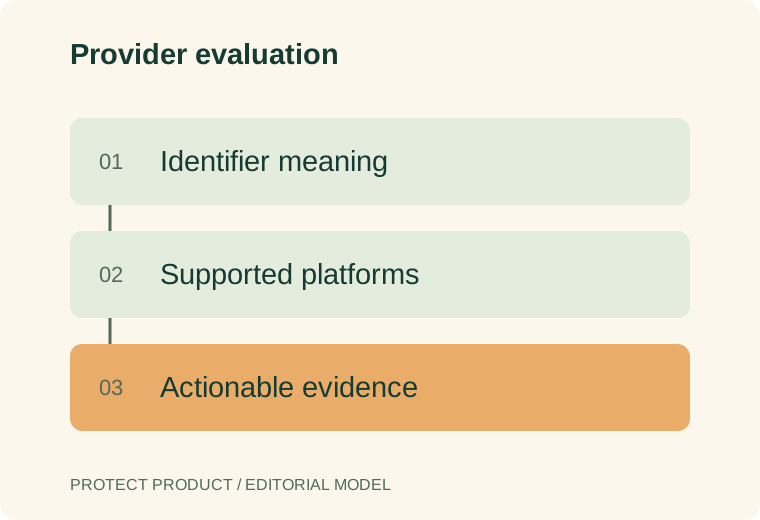
Compare the purchased platform and output
| Dimension | Evidence to request | Why it changes the purchase |
|---|---|---|
| Web and native clients | Current SDK and browser support | One platform’s fields may not exist on another |
| Returned identity | Precise entity and field definitions | Prevents confusing an event with a person |
| Risk context | Included fields and plan | Identification alone may not supply account detections |
| Server handling | Event retrieval and integrity contract | Connects the output to a protected action |
| Investigation | Search, history and review access | Determines operating work after an alert |
| Billing | Exact counted event and allowance | Makes the workload estimate defensible |
Do not treat a feature visible in a sales demonstration as included in every plan. Check the actual quote and supported client. A generous allowance can still cover a narrower set of fields than the team needs.
Use the review index to build a short list
Fingerprint is relevant to teams looking for a device-identity layer and client context. ShieldLabs combines device/network evidence with account-abuse detections. Incognia offers device and location-oriented approaches whose web and native scope should be evaluated separately.
These are different product models, not a claim that one gives the highest universal accuracy. Follow each review’s current official sources and compare the fields your app can actually use.
The device intelligence platform guide covers a broader purchase that may also include interpretation, account events and operating tools.
Test persistence without changing the meaning of the test
Choose a documented observation window and supported client set. Include returning visits, normal software changes, restricted storage and ordinary device replacement. Keep the test conditions with each result.
Record at least three outcomes separately: a changed result for a known returning environment, a shared result across different environments and a missing result. A single accuracy number can conceal those different effects on an account policy.
For example, a hypothetical service may care most about repeated introductory-benefit claims. The pilot should show how the returned identity connects to prior claims and how a legitimate household is reviewed. It should not end with a claim that a stable browser value proves one person’s legal identity.
Check the server association and failure path
Ask how your backend verifies that evidence belongs to the current account action. Inspect freshness, missing fields and the behavior of late results. Keep designated public identifiers separate from server credentials.
Choose the fallback for the specific action. A temporary uncertainty during browsing can be different from uncertainty before a costly benefit or sensitive account change. The fraud API guide provides a contract checklist for that boundary.
Do not assume that a provider’s data format is an application decision. Your app still owns authentication, permissions, offer eligibility and recovery.
Price the complete operating workflow
Estimate the collection and lookup events produced by the journeys you protect. Include normal retries and repeated visits where the service bills them. Keep identification units, risk calls, active users and optional verification in separate columns.
Then compare investigation access, retention, support, exports and the work needed to maintain your policy. Use the pricing worksheet to connect those terms to a normal month and a busy month.
Finally, inspect the fields collected and their intended use with the people responsible for your data practices. A technically available signal is not a complete decision about collection or retention.
Use product examples to narrow the first test
Public documentation gives a starting shortlist. It does not find which provider has the highest recognition rate on your devices.
| Example | Evidence source | What to verify |
|---|---|---|
| Fingerprint | Product-specific signal definitions and platform conditions | Exact SDK, plan, fields and missing-result behavior |
| Thumbmark | Browser identification, open-source library and hosted signals | Differences between the library and purchased hosted service |
| Incognia | Location and device intelligence in account journeys | Supported platforms and which account action receives the result |
Freeze the client versions and event contract for the pilot. Compare returning setups, shared devices and ordinary changes with labels supplied independently of each provider. Confirm current terms again before purchase.
FAQ
Which device fingerprinting provider is most accurate?
No universal winner is established here. Compare the same entity definition, client set, observation window and reviewed outcomes.
Does cookie independence guarantee cross-device identity?
No. Recognizing an environment without relying solely on a cookie is different from linking one person across physical devices.
What should a provider demonstration include?
A returning environment, a legitimate shared device, an ordinary change, a missing result and a reviewable server-side event association.
Sources
Editorial basis: primary-source documentation and a practical evaluation framework. Examples are hypothetical unless explicitly identified otherwise. This article does not report an independent vendor benchmark.
For evaluation standards and corrections, see our methodology and contact page.