Read this article with AI
Copy the article text into your chosen tool to inspect its sources and trade-offs.
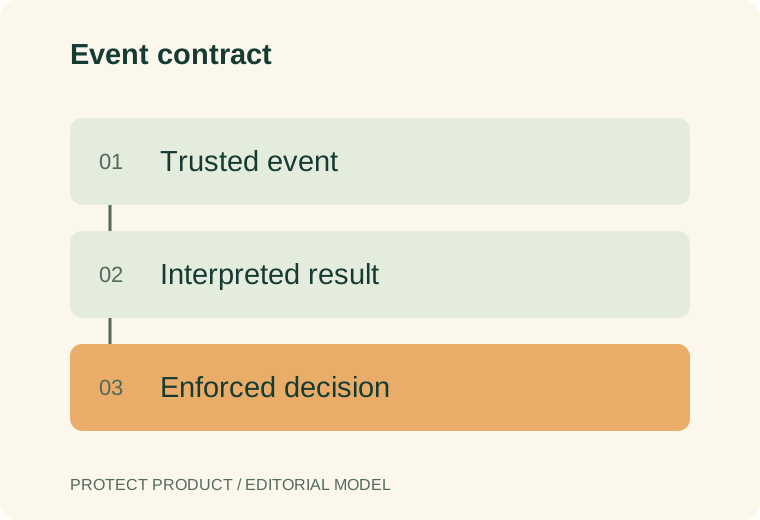
Define the event contract
Start with signup, login, benefit claim, checkout or another named action. Give it an internal event reference and timestamp. Define the account or session association available at that point, without asking the client to make unsupported identity claims.
Specify which fields the server trusts and which are client observations. Keep secret credentials on the appropriate server side. OWASP’s REST Security Cheat Sheet provides a security baseline for API access and handling.
| Contract element | Question to answer | Failure to avoid |
|---|---|---|
| Event identity | Which business action is being assessed? | Result attached to the wrong action |
| Account association | What authenticated entity is known? | Client-chosen identity treated as authority |
| Observation time | When was evidence collected? | Old result reused without a rule |
| Result semantics | Signal, score or policy instruction? | Provider scales treated as universal |
| Enforcement | Which component waits for the result? | Value released before the check |
| Outcome | What happened after the decision? | Alerts counted as confirmed fraud |
Read the response beyond the headline score
Ask what each identifier represents and whether it is stable under the conditions important to your service. Distinguish an observed environment from an authenticated account and a verified person.
For scores, document direction, scale, version and supported interpretation. A high number from one product may mean something different in another. Request examples of missing or unavailable evidence, not only a complete happy-path response.
The IP fraud score guide covers network-specific semantics. Device fingerprinting providers covers identity output. Neither output automatically becomes permission to perform an account action.
Design the result path and fallback together
Define a time budget for the protected action and what happens when the risk service does not respond. A reversible low-value event and a value-releasing operation may need different fallback policies. Assign an owner for choosing and reviewing them.
In a hypothetical service, an expensive job request reaches a risk API that times out. The application should preserve a coherent pending or fallback state under its agreed rule. An unknown result should not be logged as a confident pass simply because the request handler needs to finish.
For request-level automation controls, see bot detection API integration. For resource release, see AI trial abuse controls.
Make retries and incoming events safe
Use the provider’s documented retry and idempotency rules. Keep the internal business operation distinct from transport attempts. Several HTTP requests may represent one action; several independent actions should not be collapsed merely because their payloads look similar.
When the provider sends asynchronous updates, verify them using its supported mechanism, deduplicate deliveries and reconcile them with the original event. Stripe’s idempotency reference is a concrete example of one provider’s semantics, not a specification for every fraud API.
Record late results separately when enforcement has already occurred. They may help investigation without retroactively changing what the application actually did.
Evaluate platforms, privacy and operating access
Confirm web, native mobile and server support for the purchased product. Check required permissions, data sent, retention, export and deletion behavior. A JavaScript integration example does not establish support for every client platform.
Give reviewers enough evidence to investigate without exposing secret tokens or unnecessary raw personal data in general logs. OWASP’s Logging Cheat Sheet helps structure that review.
Name the team that maintains policy, handles customer exceptions and contacts the supplier during outages. An API subscription does not provide those responsibilities automatically.
Compare total cost on a realistic workload
Count the unit the provider bills: lookup, event, identification, request or another measure. Model retries, optional products and test environments. The fraud pricing guide helps normalize quotes.
Run an authorized pilot with both legitimate and known abusive cases, plus missing evidence and timeouts. Record response coverage, latency, review work and confirmed outcomes separately. Choose the API that improves the named decision at a cost and customer impact your team can explain.
FAQ
Does a fraud API block users automatically?
Some products return policy instructions or offer enforcement integrations; others only return evidence. Confirm the exact contract and application behavior.
Are fraud scores comparable across providers?
Not by default. Check scale, direction, definition, inputs and evaluation population before comparing them.
What should happen when the API times out?
Use a documented fallback appropriate to the protected action. Retain the unavailable result honestly and reconcile later events where supported.
Sources
Editorial basis: primary-source documentation and a practical evaluation framework. Examples are hypothetical unless explicitly identified otherwise. This article does not report an independent vendor benchmark.
For evaluation standards and corrections, see our methodology and contact page.