Read this article with AI
Copy the article text into your chosen tool to inspect its sources and trade-offs.
Read the score definition before choosing a threshold
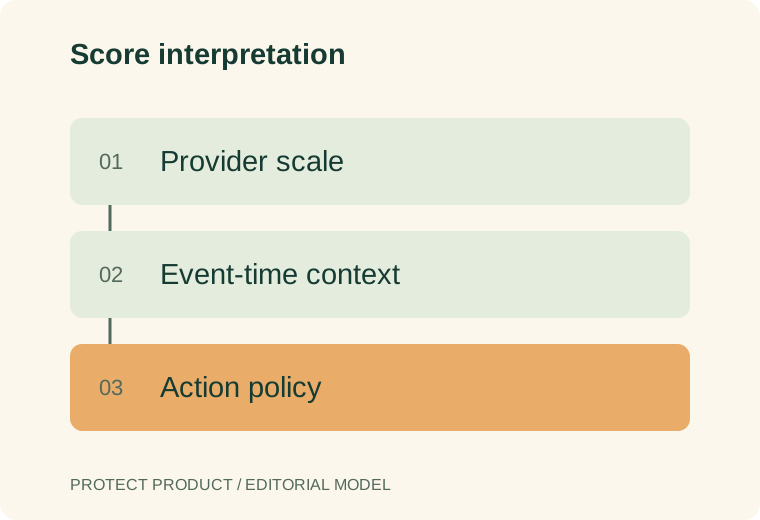
Ask what the score evaluates: an IP address, transaction, identification event or account. Check whether higher values mean more risk, what the endpoints represent and how unknown or unavailable results are encoded.
Two services can both return a number while evaluating different entities and evidence. Do not compare the same numeric threshold across them without a documented basis. A service’s historical reputation field and a current request assessment can also have different time meanings.
The signals-versus-decisions guide explains how a number becomes an application policy. The score supplies context; the app chooses a response for a specific action.
Keep network reputation and device evidence separate
| Evidence type | Useful question | What it cannot settle alone |
|---|---|---|
| IP category or reputation | What is known about this network context? | Who is operating the account? |
| Device or browser context | Does this environment relate to earlier activity? | Is the person legally identified? |
| Account history | What has this account done? | Whether every current session is authorized |
| Business event | Is this claim or transaction eligible? | The complete risk of unrelated future actions |
MaxMind’s anonymizer documentation distinguishes several network-related product fields and scopes. Use precise field definitions rather than treating a broad “anonymous IP” label as a verdict about the customer.
Investigate surprising scores through their context
Confirm which address was submitted and how the trusted client-IP boundary was established. A reverse proxy or missing forwarding configuration can cause the app to assess the wrong endpoint. The proxy API guide covers this input problem.
Then inspect observation time and category details. A customer can change networks, and many legitimate users can share one address. Keep the result tied to the original event instead of interpreting a later lookup as exactly the same evidence.
For a hypothetical subscription app, an established customer on a privacy service may receive a network-related signal. The appropriate response also depends on the action: ordinary browsing and changing a payout destination are not the same decision.
Calibrate the policy on reviewed outcomes
Choose a defined cohort and preserve the score, policy version, action and later outcome. Inspect which customers would be allowed, verified or reviewed at a proposed threshold. Keep unreviewed cases as unknown outcomes.
Compare legitimate completion and investigation work alongside confirmed loss. A stricter threshold can increase alert volume without improving the business result. The false-positive guide explains why precision and false-positive rate use different denominators.
Do not publish a threshold from a small test as a universally correct rule for banks, marketplaces or SaaS products. The protected action, user population and source of the score all matter.
Give uncertain and failed results explicit states
An unavailable service is not the same as a low score. An unsupported address family or missing field also deserves its own handling. Preserve the failure reference so the operating team can separate data gaps from evaluated customers.
Choose the fallback per action. A low-cost operation might continue under a documented policy while a sensitive change uses another verification route. Support should know which state caused the response.
The account-risk guide provides a matrix for sensitive actions. A score should fit that model rather than silently overriding authentication or customer recovery.
Use the score as one part of procurement
Ask how a vendor explains results, supports review and handles changes to its output. Confirm the billing unit and included context. A bare IP lookup, a full risk event and a packaged account detection are different purchases.
For combined device/network and account evidence, inspect the ShieldLabs review. For narrower network lookups, compare the relevant tools in the review index. The right choice depends on the decision and operating work your team already owns.
Keep the final evaluation memo clear about what was established: response meaning, integration correctness and reviewed policy outcomes. A polished score display does not establish universal fraud-detection accuracy.
FAQ
Is an IP fraud score a probability that a person is fraudulent?
Not unless the provider’s documented model explicitly establishes that meaning. Read the evaluated entity and score definition carefully.
Can I use the same threshold with another vendor?
Do not assume equivalent scales or evidence. Reevaluate the policy against the new service’s contract and your reviewed outcomes.
What if the score is missing?
Keep that state distinct from an evaluated negative result and use the fallback defined for the protected action.
Sources
Editorial basis: primary-source documentation and a practical evaluation framework. Examples are hypothetical unless explicitly identified otherwise. This article does not report an independent vendor benchmark.
For evaluation standards and corrections, see our methodology and contact page.