Read this article with AI
Copy the article text into your chosen tool to inspect its sources and trade-offs.
Read the sequence around the event
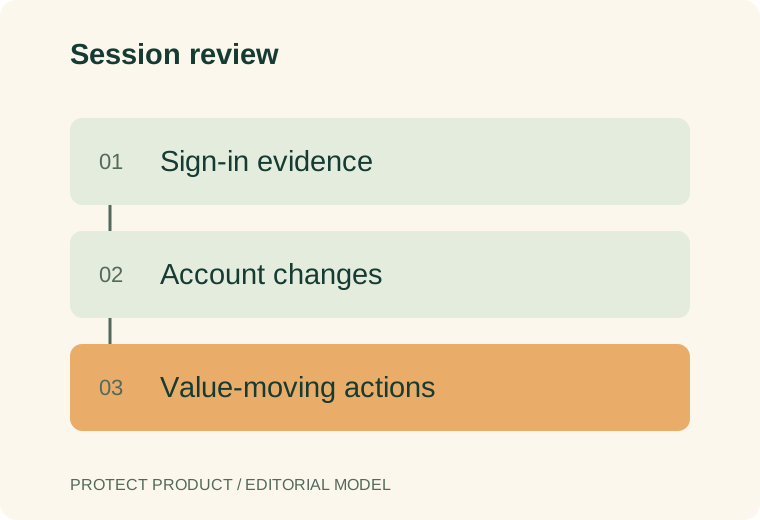
A single login may look ordinary until it is followed by a recovery-email change and a new payout destination. The reverse is also possible: an unfamiliar device may belong to the legitimate owner after a phone replacement. Keep the sequence available to the service or analyst making the decision.
Use separate references for the account, session, observation and protected action. Record when each happened. Without timing, an older device result can be accidentally treated as current evidence for a later operation.
The fraud API guide explains how to keep that association explicit. A risk result should be inspectable in the context of the action it informed.
Assign responses by action sensitivity
| Action | Evidence to examine | Policy question |
|---|---|---|
| Routine sign-in | Authentication and environment context | Can this session proceed normally? |
| Recovery-detail change | Current authority, recent events and verification | Is the owner authorizing the change? |
| Privileged role change | Account permissions and fresh authorization | May this session grant wider access? |
| Payout destination change | Account, transaction context and verification | Should the instruction be delayed or reviewed? |
| Data export | Current authority and requested scope | Is this export permitted now? |
These are policy questions, not universal thresholds. The same observation can justify a different response at a different point in the journey. Document the decision owner and the recovery path for each sensitive action.
Interpret a changed device or network carefully
Environment changes can be legitimate. Ordinary travel, a privacy service, a changed connection or a different browser can alter observations. Ask what the signal actually establishes before turning it into a customer-facing accusation.
Device recognition and a valid authenticated session are separate concepts. OWASP’s authentication guidance explicitly treats device and network characteristics as risk inputs rather than replacements for authentication.
When location is relevant, check event time and uncertainty too. The location-spoofing guide explains why a network location and an independently collected device location should not be treated as interchangeable facts.
Include passwordless enrollment and recovery
A passwordless normal sign-in does not remove the need to protect enrollment, factor replacement and account recovery. Inventory the alternate ways a session can gain authority. Then inspect what evidence is available before a sensitive change becomes effective.
For a hypothetical SaaS workspace, a member adding an ordinary collaborator and an administrator granting billing access may require different checks. The response should follow the application’s permission model. A generic risk alert should not invent a new role or bypass the existing authorization boundary.
Retain a safe notification and support route when a consequential change occurs. Avoid using an unverified newly supplied address as the only channel for resolving a disputed change.
Keep missing evidence visible
A blocked collector, delayed event or unavailable assessment creates uncertainty. Store a separate state for it. If the system silently substitutes a normal score, the operations team cannot distinguish a clean assessment from a gap in collection.
Define fallback behavior for each sensitive action. An account may still be able to browse while a payout change waits for an alternate verification step. Test the fallback in a controlled environment and confirm that support can explain it.
The credential exposure guide covers another uncertainty: an exposure alert may be relevant without proving that the current session is compromised.
Build an incident record that supports recovery
Preserve the protected action, policy version, observations used, response and later review outcome. Restrict access to sensitive evidence according to the business’s data practices. A normal support ticket should not become a copy of raw device records or secret authentication material.
Measure confirmed incidents, legitimate completion, time to recovery and policy reversals. Compare similar customer cohorts when changing the rule. Session recordings can provide workflow context where appropriate, but a recording alone does not establish who controlled the account.
Use the account takeover buyer guide when a new product is needed to fill a specific evidence or operating gap.
FAQ
Does a new sign-in location prove account takeover?
No. Evaluate the session, authentication and requested action along with the observation’s uncertainty and possible legitimate explanations.
Can risk signals protect a passwordless journey?
They can inform sensitive-action and recovery policies. They do not replace the credential, session or authorization checks required by that journey.
What should a support agent see?
A decision reference, the applicable policy, a safe explanation and an authorized recovery procedure. Avoid exposing unnecessary raw observations or credentials.
Sources
Editorial basis: primary-source documentation and a practical evaluation framework. Examples are hypothetical unless explicitly identified otherwise. This article does not report an independent vendor benchmark.
For evaluation standards and corrections, see our methodology and contact page.