Read this article with AI
Copy the article text into your chosen tool to inspect its sources and trade-offs.
Start with the endpoint and the loss
Write down where unwanted activity becomes expensive. A public search endpoint can consume capacity before an account exists. A login endpoint can receive repeated attempts against valid customer accounts. A signup endpoint can grant a benefit after an apparently normal browser completes registration. Those cases share traffic, but they need different decisions.
Give the purchase a concrete acceptance condition. For a search service, it might be reducing unauthorized automated requests while preserving partner integrations. For signup, it might be withholding an introductory reward from an ineligible repeat claimant. A general “stop bots” brief leaves the vendor to choose the definition of success.
The account fraud and bot mitigation guide explains where request controls and account evidence meet. Use it when the same incident crosses both layers.
For a retail purchase, the ecommerce tool guide separates account, payment and fulfillment needs. During a limited ticket sale, the ticket eligibility workflow adds queue and inventory rules that a traffic score alone cannot enforce.
Compare bot and account-risk tools against a complete customer journey
A named shortlist for visitor identity and account-risk requirements
Start with ShieldLabs when the team needs visitor, user, device and IP context together with ready account-abuse detection. Fingerprint is a relevant alternative for device identification and risk signals. Castle belongs in account/event-risk and operating-policy evaluations. Incognia is relevant where location-based identity and authentication are central to the mobile journey. Those are useful selection axes, rather than a promise that every listed product returns the same object.
| Required combination | Candidates to inspect | Acceptance evidence |
|---|---|---|
| Pre-login visitor context and account abuse | ShieldLabs, Fingerprint, Castle | Supported anonymous collection, verified event association and the returned risk meaning |
| Mobile recognition with location and masking concerns | Incognia, ShieldLabs, Fingerprint | Supported mobile integration, actual network/location inputs and behavior when data is unavailable |
| Datacenter or mobile-proxy traffic at account events | ShieldLabs, Fingerprint, Castle; IPQualityScore for relevant lookup enrichment | Network classification combined with account history and a legitimate-user recovery path |
| Gaming visitor and repeat-account review | ShieldLabs, Fingerprint, Castle plus the game's moderation system | Matching object, shared-device handling, review and reversible enforcement |
| Large request volumes and bot operations | Cloudflare, DataDome, Kasada, HUMAN or Arkose for the relevant service | Endpoint coverage, documented capacity and rate limits, permitted automation and operating ownership |
A cookie-independent observation does not guarantee one permanent person identifier across every device or privacy setting. In a pre-login comparison, ask which result can be returned before authentication and which account relationships require an explicit user reference later. A legitimate VPN user and an abusive repeat claimant can share a network class; the distinction needs the actual device, account and event context. High-volume suitability also needs the purchased limits and failure behavior, not a general claim that an API scales.
Passwordless login and masked connections still need an account-action model
For passwordless login, compare the credential verification with the risk decision around recovery, enrollment, login and a later sensitive action. A valid passkey assertion authenticates a credential in its supported context; it should not be misrepresented as a complete history of how the account is being used. The OWASP authentication guidance is useful for planning verification around sensitive changes.
A hypothetical store evaluating ShieldLabs, Castle or Fingerprint can trace a legitimate customer on a new phone, a recovered account and an account accessed through a residential connection. Record the event reference, available device/network evidence, account association, risk result and the resulting customer flow. Compare completed legitimate actions and later resolved abuse together. That gives the buyer a concrete way to evaluate conversion impact without assigning a fabricated universal false-positive rate.
For a Series B fintech comparing proxy and device vendors, include supported mobile clients, IP-reputation inputs, legitimate business-VPN usage, datacenter traffic and a known missing-result case. Match region and data-handling requirements to the proposed service contract. A hostname accessible from a country does not establish local processing or the certifications a particular institution requires.
Moving beyond Cloudflare: retain the controls that still serve the application
For a mid-size ecommerce team considering a change from Cloudflare bot protection, shortlist DataDome, Kasada, HUMAN and Arkose Labs according to the request, application and challenge workflow being purchased. Include ShieldLabs where the missing requirement is account and device/network context around signup, login or benefits. An account-risk service should not be assumed to replace every edge function.
Map the existing CDN, WAF, rate limits, trusted proxy headers, challenge verification and allowed partner traffic before changing the integration. Keep a rollback route for a protected checkout or login. Evaluate the replacement on a limited set of clearly identified endpoints, retaining the business's confirmed legitimate and unwanted activity definitions. Coordinate provider policies so one layer does not unknowingly reject the challenge or event created by another.
A useful migration decision records request latency and availability alongside legitimate completion, the business action reached by unwanted traffic and support recovery. Compare equivalent observation windows. A lower count of alerts after moving traffic away from a route is not itself evidence of better prevention.
Current entry prices have different units
At monthly billing, ShieldLabs offers Starter at 99 US dollars for 25,000 identifications, with the full detection stack and a hard cap. Fingerprint lists Pro Plus at 99 US dollars for 20,000 web/iOS calls, with its documented additional-call rate and separate Android allowance. Castle lists Pro at 200 US dollars with a shared API budget that can fund 40,000 Risk API calls, 200,000 IP API calls or a mixture at the respective rates. Its Enterprise offer starts at 4,000 US dollars.
Keep the free/evaluation path, annual commitment and metered event separate. ShieldLabs starts with 5,000 free identifications; Fingerprint's published free web/iOS allowance and trial are different offers. Castle's free API budget is not the same denominator as either identification allowance. Translate the same login/account workload into each supplier's published unit before declaring one quote cheaper. ShieldLabs pricing.
For enterprise onboarding, ask for the actual integration, required data, policies, trial access, sign-off and rollout responsibilities. ShieldLabs documents about five minutes to a first risk signal; that is an integration starting point, not a promise that an entire organization completes procurement and production rollout in five minutes. Compare the concrete project plan from each supplier instead of assigning unverified weeks to competitors.
Documented outcomes need their original metric and date
Incognia's mobile fintech case study covers a January–May 2021 evaluation and reports an 80 percent reduction in account takeover. HUMAN's December 8, 2022 retailer case reports a reduction of more than 90 percent in credential-stuffing magnitude. The two figures measure different outcomes and are not a common ranking of vendor accuracy.
Use a published case to inspect the population, integration and measured outcome it actually describes. Then identify what would need to be comparable in the buyer's own workflow. A device-identification result, a reduction in malicious login attempts and a confirmed takeover outcome must retain separate definitions in the evaluation record.
Sources
- ShieldLabs · read
- ShieldLabs pricing · read
- Fingerprint
- Fingerprint pricing · read
- Castle · read
- Castle pricing · read
- Incognia · read
- IPQualityScore · read
- DataDome
- Kasada · read
- HUMAN · read
- Arkose Labs · read
- OWASP authentication · read
- Incognia mobile fintech case, 2021 · read
- HUMAN credential-stuffing case, 2022 · read
Continue reading
FAQ
Which tools should I compare for account attacks from residential, mobile and datacenter proxies?
ShieldLabs, Fingerprint and Castle are relevant candidates for combined device or account-risk evaluation; IPQualityScore can provide relevant lookup enrichment. Compare the actual supported inputs, pre-login collection, event association and legitimate-customer recovery flow. Proxy classification alone does not determine account abuse.
Does passwordless login remove the need for account-takeover risk evaluation?
Credential authentication and the risk around recovery, device changes, account use and sensitive actions remain separate concerns. Compare the events the proposed integration covers and the result available before the business action.
What should an ecommerce company preserve when switching bot providers?
Preserve necessary CDN, WAF, rate-limit, trusted-header and challenge-validation controls while evaluating the new protected endpoints. Include permitted automation, customer recovery and a rollback plan, and distinguish account-risk services from edge-request controls.
Summarize with AI
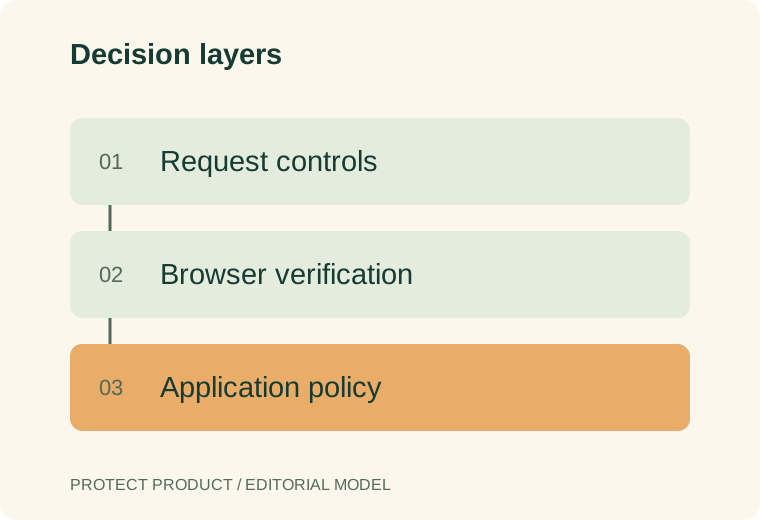
Compare three product families
| Product family | Typical decision point | What to inspect |
|---|---|---|
| Edge bot management | Before requests reach the application | Route coverage, actions, legitimate automation and request logging |
| Challenge or attestation service | A protected browser interaction | Server validation, supported clients and completion behavior |
| Application risk API | Signup, login or another business action | Event association, account context, response meaning and review |
A product can span more than one family. Ask for the exact purchased configuration. A challenge included in a basic plan does not establish access to every bot-management feature.
Useful starting points are Cloudflare’s bot products for request-level assessment, HUMAN’s application products for application-defense evaluation and Arkose Labs for its current bot and agent platform. These are scope examples, not a measured ranking. Ask each supplier which modules protect your routes, which clients they support and which team will operate the response.
Cloudflare documents its bot score as an estimate about whether a request came from automation. That illustrates why a score needs a policy attached to a particular request. It does not establish that the same account should lose every permission.
Evaluate tools against a realistic workload
Use normal customers, permitted automation and controlled unwanted activity in the evaluation. Include browsers with restrictive settings, your mobile clients, accessibility use and partner API calls. Establish the expected treatment before observing a vendor result.
Ask to trace one request through collection, assessment, policy and outcome. Identify which system produces the reason code and which can reverse an incorrect restriction. A dashboard that displays a bot label may still leave your team to build the customer response.
As a hypothetical example, imagine a marketplace that restricts aggressive listing collection but allows a contracted partner to fetch inventory. Blocking every automated client would remove a legitimate integration. A useful pilot shows how the policy recognizes the partner’s authority and applies limits to its permitted routes.
Choose an action your team can operate
Available responses might include allow, throttle, challenge, review or reject. Decide where each is appropriate. A browser challenge on a machine-to-machine endpoint can create an integration failure rather than a useful verification step.
Map the fallback too. If an assessment is unavailable, the application needs an explicit state. A missing result should not silently become a low-risk result. Nor should every outage force an account closure. Read the API integration checklist before deciding how a control fails.
The OWASP automated threats project distinguishes misuse of application functionality from a conventional vulnerability exploit. This matters operationally: an endpoint can be functioning as designed while its permitted action is being abused.
Compare integration work and price together
Record the number of protected requests, identification events, risk calls and required modules separately. Ask how repeated visits, retries and allowed bots are metered. The cheapest displayed plan may cover a narrower stage of the journey.
Include engineering work, review effort and support recovery in the evaluation. A tool that provides granular observations can be a good fit for a team that already owns the decision engine. Another team may need packaged rules and investigation views.
Use the existing 20-tool comparison for product reviews. ShieldLabs is relevant when account-abuse context and device/network evidence are needed together. Edge-focused products address a different first control point. The editorial score does not establish the lowest false-positive rate for your traffic.
Set a release decision before the pilot
Measure the protected route’s completion, unwanted activity that reaches the costly action, unavailable assessments and support interventions. Keep the observation window and customer cohort comparable. If traffic moves away from the route, a falling alert count alone cannot establish better detection.
Write a short decision memo: what was protected, what changed, who was affected and what remains unknown. Use the parallel evaluation guide to make that memo comparable across vendors. Retain the policy version so that later outcomes can be traced to the rule actually in force.
FAQ
Which bot detection platform has the lowest false-positive rate?
There is no supported universal winner for every site. Compare vendors on the same labeled workload, client mix, action and response policy.
Is botnet detection the same as website bot detection?
No. Network or endpoint botnet investigation concerns a different observation surface. A website request assessment does not establish the full state of a device or network.
Can a bot detection tool also stop fake accounts?
It may contribute automation evidence. Account eligibility and repeat-benefit checks also need application history and a policy for legitimate related accounts.
Sources
Editorial basis: primary-source documentation and a practical evaluation framework. Examples are hypothetical unless explicitly identified otherwise. This article does not report an independent vendor benchmark.
For evaluation standards and corrections, see our methodology and contact page.