Read this article with AI
Copy the article text into your chosen tool to inspect its sources and trade-offs.
Follow the booking through its states
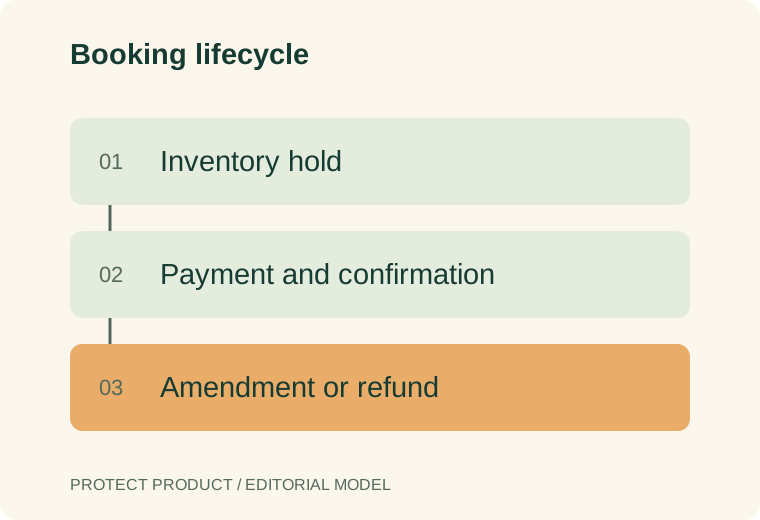
Write the sequence from search to hold, payment, confirmation, amendment and cancellation. A search request does not have the same cost or authority as changing a passenger detail or refund destination. Name the system that owns each state.
Keep supplier confirmation separate from the platform’s payment record. If either remains pending, show operations the unresolved step. A customer should not receive a final promise merely because one component finished.
| Journey step | Risk question | Appropriate evidence |
|---|---|---|
| Search | Is traffic harming service or inventory discovery? | Request behavior and service load |
| Hold | Is inventory being reserved under valid rules? | Hold ID, expiry and entitlement |
| Purchase | Is payment and order acceptance complete? | Provider status and booking reference |
| Amendment | Is this actor allowed to change the trip? | Authentication and change history |
| Refund | Where should value return? | Original purchase and approved resolution |
Protect inventory without blocking ordinary research
Customers compare dates, destinations and prices. High browsing volume can be legitimate, especially during disruptions. Decide which requests need limits based on the capacity or inventory they consume.
For a hypothetical platform, browsing alternative dates does not reserve a room. Creating a hold does. A control at the hold boundary can address repeated reservation pressure without treating every comparison search as a purchase attempt.
The bot detection tools guide helps distinguish traffic controls from account risk. If an external supplier has its own rate and booking rules, record those constraints in the integration.
Treat travel geography as context
The account’s home address, current device location, network location and trip destination can legitimately differ. IP location may be affected by corporate networks or privacy services. Device location also has accuracy and permission limits.
Use the event time and the source of the location claim. Missing permission is a missing observation, not proof of spoofing. See location spoofing detection and VPN and proxy tools for narrower evaluation methods.
Include real travel scenarios in a pilot: a customer booking for someone else, a new phone abroad and an office assistant arranging business travel. Apply the service’s actual account and purchase policy to each.
Verify authority for sensitive changes
An account can be legitimate at booking and compromised later. Changes to recovery details, itinerary access, refund destinations or account permissions deserve their own checks. OWASP’s Authentication Cheat Sheet discusses reauthentication for sensitive operations.
Keep delegated travel management distinct from unauthorized sharing. If assistants or agencies are allowed, model their permissions explicitly instead of expecting a device score to infer the business relationship.
Use account sharing detection for seat and delegation questions, and account takeover signals for compromise investigations.
Reconcile amendments and refunds
A changed itinerary can produce a new price, supplier charge or refund. Link every adjustment to the original booking and the relevant supplier event. Do not overwrite the previous state without an audit trail.
Use provider documentation for the exact payment method. A browser return or support note should not independently establish that a refund completed. Separate customer resolution, supplier settlement and payment status so operations can identify the unfinished step.
Judge the complete booking outcome
Track confirmed fraud loss, inventory held without completion, legitimate booking failures, review time and amendment errors. Segment by route or channel only when the sample supports a meaningful comparison. Do not assume international bookings are a fraud cohort.
Test one booking path through purchase and a later amendment before broad rollout. The best first control is the one that addresses a measured loss at a step your team can operate and explain.
FAQ
Is an IP country different from the destination suspicious?
It is ordinary travel context. Consider what each location represents before deciding whether further review is needed.
Can bot controls stop all travel fraud?
No. Account compromise, payment disputes and supplier or refund errors need additional controls and records.
Where should an inventory-abuse control run?
At the operation that consumes inventory or capacity, using the platform’s actual reservation and expiry rules.
Sources
Editorial basis: primary-source documentation and a practical evaluation framework. Examples are hypothetical unless explicitly identified otherwise. This article does not report an independent vendor benchmark.
For evaluation standards and corrections, see our methodology and contact page.