Read this article with AI
Copy the article text into your chosen tool to inspect its sources and trade-offs.
Translate the subscription into an enforceable model
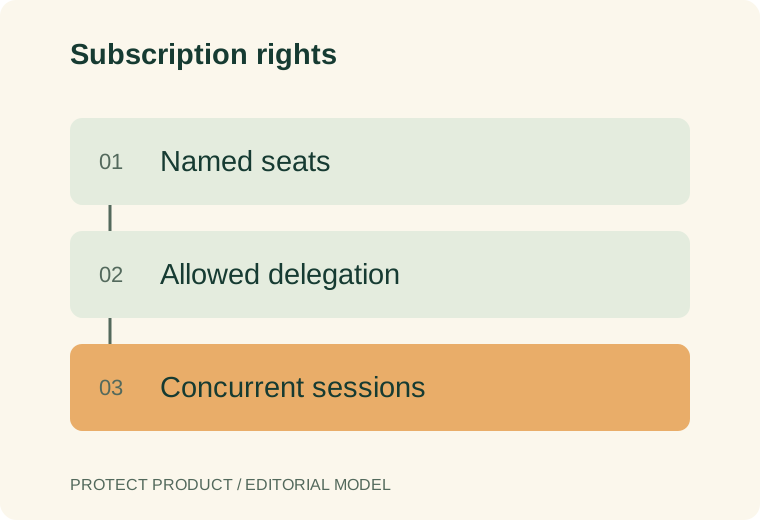
Define whether a subscription belongs to a person, household, team or organization. Record permitted seats, concurrent sessions and any relevant device rules. Product copy and backend entitlement checks should describe the same purchase.
A business account with several named seats is different from a single-user subscription used by several people. The detection task is not simply counting devices. One legitimate customer may work from a laptop and phone, replace hardware or travel.
Use the signals-versus-decisions guide to keep evidence separate from the entitlement decision. The account’s plan determines which use is permitted.
Inspect session evidence in context
| Observation | Possible legitimate explanation | Policy context needed |
|---|---|---|
| Several devices | Phone, laptop, replacement device | Device and seat allowance |
| Overlapping sessions | Background tab, mobile app or permitted concurrent use | What counts as active use |
| Different network locations | Travel, privacy service or mobile routing | Timing and location uncertainty |
| Repeated switching among users | A shared workstation or unauthorized shared credential | Named-seat and account rules |
| Rapid sensitive changes | Recovery or control changes | Account-security investigation |
Keep an active-use definition. A stored session that has not performed a relevant action may not represent a concurrent viewer or active worker. Count the business event your policy actually restricts.
Separate sharing from a possible takeover
An unfamiliar environment can concern account security rather than intentional subscription sharing. Customer support needs a safe way to distinguish those cases. Do not assume that every customer knowingly violated the terms.
If evidence suggests an unauthorized session, use the account takeover response model. The normal authentication system should manage session authority and recovery. A sharing detector should not independently expose private account data.
OWASP’s session-management guidance is useful when reviewing the surrounding session lifecycle. Session handling and subscription policy remain connected but distinct responsibilities.
Choose a proportionate first response
Possible responses include explaining the limit, asking the customer to manage sessions, offering another seat or reviewing an ambiguous case. A disputed access event does not always require closing the account.
For a hypothetical design SaaS, a workspace may allow three named collaborators but prohibit sharing one member credential among contractors. A useful policy helps the administrator assign seats and resolve access. Blocking all activity from a shared office network would not implement that policy correctly.
Record which exception support grants. An exception for a temporary device change should not become a permanent exemption from every account rule. Keep the account reference, rationale and relevant expiry or review condition.
Evaluate tools on the full account journey
Ask a vendor what it observes, how it associates sessions with accounts and what evidence supports a sharing event. Confirm supported web and native surfaces. Inspect how the system treats an invited member, a returning device and a customer using a privacy service.
ShieldLabs is one reviewed option for account-sharing events alongside device/network context. An identity-focused input such as Fingerprint may fit a business that already owns the relationship and policy logic. The review index helps compare those operating models without assuming identical features.
Request a demonstration of an incorrect relationship being corrected. A technically impressive link is less useful if support cannot explain or reverse the resulting restriction.
Measure retention and recovery alongside enforcement
Track confirmed entitlement violations, customers who add legitimate seats, mistaken restrictions and time to resolution. Keep these outcomes separate from alert counts. An aggressive rule can reduce concurrent sessions while also causing valid customers to leave.
Inspect the observation window and relevant usage denominator. A change in campaign mix or a product release may change device and session counts without changing sharing behavior. Retain the policy version and cohort definition when comparing results.
For benefits tied to a subscription, use the free-trial guide. Entitlement to an introductory offer and permission for ongoing multi-device use are different rules.
FAQ
Do multiple devices prove account sharing?
No. Interpret device and session evidence against the subscription’s permitted users and use patterns.
Can tools enforce seat limits automatically?
Automation is possible only after the application defines seats, evidence and responses. Verify the integration and recovery path before enabling restrictions.
How can a streaming or SaaS business avoid blocking travelers?
Use timing, location uncertainty and the entitlement model instead of a blanket unfamiliar-location rule. Test legitimate travel and privacy-tool use during the pilot.
Sources
Editorial basis: primary-source documentation and a practical evaluation framework. Examples are hypothetical unless explicitly identified otherwise. This article does not report an independent vendor benchmark.
For evaluation standards and corrections, see our methodology and contact page.