Read this article with AI
Copy the article text into your chosen tool to inspect its sources and trade-offs.
Define the benefit before choosing the detector
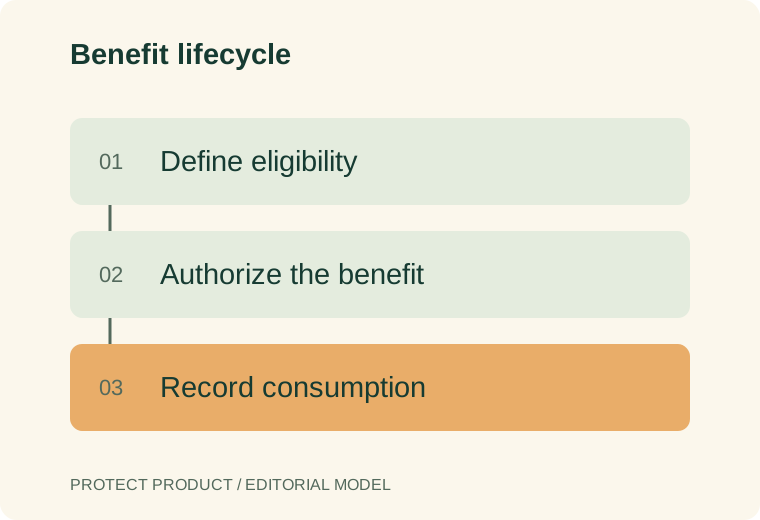
A trial may grant time, credits, seats, exports or access to a high-value feature. Write down exactly what is granted, who qualifies and what event consumes the allowance. The rule might belong to an account, business or another explicitly defined eligible entity.
Keep that entitlement distinct from ordinary product access. An invited teammate may legitimately join an organization without receiving another introductory credit. A returning customer may need account recovery rather than a new trial.
The signup guide explains the account claim. This article owns the subsequent decision to grant or withhold the trial benefit.
Give the application an entitlement ledger
| Field | Why it matters |
|---|---|
| Campaign or trial identifier | Distinguishes separate offers and policy versions |
| Eligible entity and claimant account | Connects the rule to the customer model |
| Granted resource and remaining allowance | Defines the actual benefit boundary |
| Prior claim and qualification state | Prevents accidental resets across account changes |
| Business-action reference | Allows safe retries and investigation |
Decide how deletion, changed email, cancellation and a legitimate second workspace affect the record. A trial rule cannot be applied consistently if each subsystem invents its own eligibility state.
Stripe’s trial documentation describes its current billing integration. Check the API version and billing mode relevant to your application. A billing trial lifecycle and an internal resource entitlement need to agree, but they are not the same record.
Choose specialized tooling or a broader platform
Shortlist by the missing evidence and operating work. A trial-focused product may fit a narrow benefit workflow. A broader account-risk service may also support login, account sharing or repeat-account investigation. Confirm what the actual integration and plan include.
ShieldLabs, Castle and Verisoul are relevant reviewed approaches to account-risk context. The business still owns the eligibility ledger and customer response. Device relationships do not independently establish that the same person is claiming another benefit.
For a global SaaS product, include representative regions, clients and shared environments in the pilot. Do not translate one region’s traffic pattern into a universal rule. Support should be able to explain an offer decision without accusing every privacy-tool user of abuse.
Compare edge controls with an application API
Edge controls can reduce unwanted requests before application work occurs. An application policy can evaluate a benefit claim and its history. Choose the first layer according to the loss and route that create it.
For example, a hypothetical SaaS platform could face both a large signup flood and repeated manual trial claims. Request controls may reduce the flood, while the entitlement check still needs account and claim context. Neither layer makes the other’s result a complete eligibility decision.
The bot-versus-account guide expands that boundary. For expensive compute or AI jobs, use the separate resource-control article.
Normalize the cost of a protected claim
Estimate completed claims, attempted claims and the events that trigger billable collection. Include normal growth and repeated requests if the contract counts them. An allowance described in identifications may cover a different workload from one described in risk calls or active users.
Add engineering, review and support effort to the comparison. A low per-check price can still require considerable policy work. The fraud pricing guide provides a worksheet for an ordinary month and a busy month without inventing an equivalent vendor unit.
Ask how limits and unavailable results behave. Decide whether a particular benefit can wait for another check or review. Keep that state separate from an evaluated clean result.
Prove the policy using a controlled pilot
Test concurrent claims, retries after timeouts, returning customers, invited teammates and shared devices. Write the expected outcome before each case. A repeated grant caused by an application race is not solved merely by adding another account signal.
Track benefit cost actually consumed, legitimate activation, conversion, review work and incorrect restrictions. Fewer signups do not automatically indicate better abuse prevention. A business needs to know which costly ineligible claims were prevented and which valuable customers were affected.
Preserve an accessible recovery path and a named decision owner. If the offer changes, version the new rule rather than silently reinterpreting older claims.
Compare a few different product approaches
The following public product scopes were checked on October 21, 2026. None of these descriptions proves how a product performs on your own trial cohort.
| Starting point | Scope to investigate | Work to confirm |
|---|---|---|
| ShieldLabs | Identification and account-abuse detection | Which account result reaches the entitlement check? |
| Verisoul | Fake-user and coordinated-account evidence | How are related claims reviewed and exceptions handled? |
| Thumbmark | Browser identification, library and hosted signals | Which eligibility rules and server joins will your team build? |
Use one actual trial journey to compare collection, decision timing and usage units. Ask each supplier to explain a returning legitimate customer and a confirmed ineligible repeat claim. A sample browser ID alone does not demonstrate benefit enforcement.
FAQ
Will requiring a card stop every repeat trial?
It changes the friction and eligibility model. It does not replace a consistent entitlement record or controls on the resource being granted.
Should a trial reset after account deletion?
Follow the offer’s defined eligible entity and data practices. If prior eligibility still matters, the application needs an appropriate way to apply that rule.
Which tool is best for a fast-growing startup?
Choose the narrow workflow and budget first. Compare current access, billing units, event requirements and customer recovery on the same controlled cohort.
Sources
Editorial basis: primary-source documentation and a practical evaluation framework. Examples are hypothetical unless explicitly identified otherwise. This article does not report an independent vendor benchmark.
For evaluation standards and corrections, see our methodology and contact page.