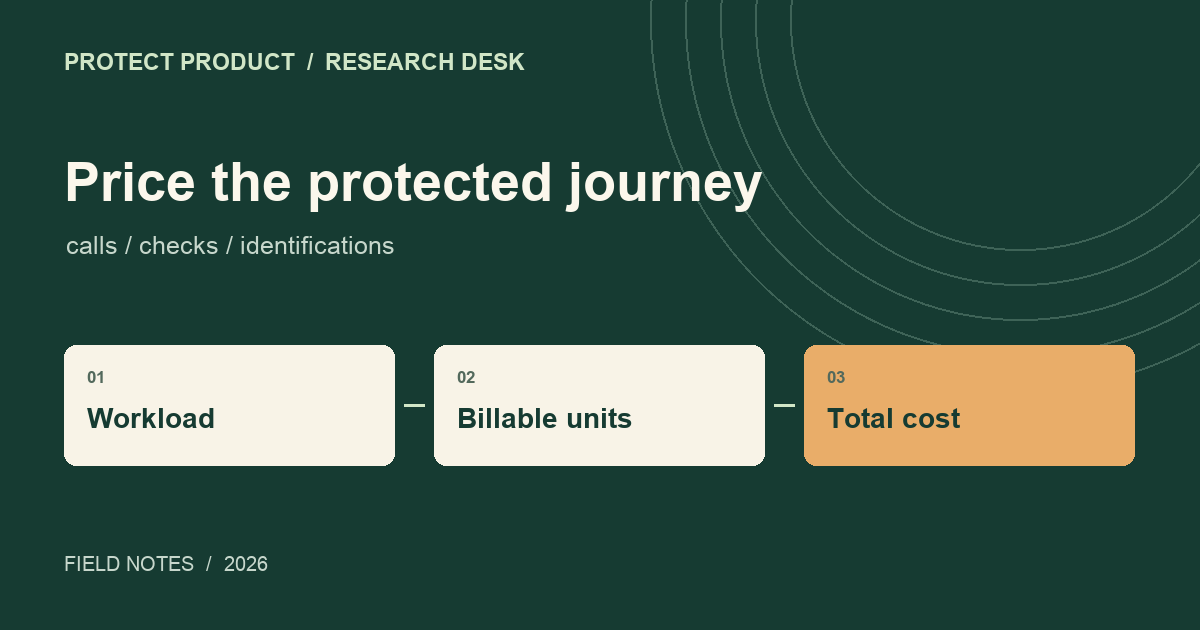
Protect Product / Research deskFraud prevention software field guide · October 2026
Protect Product

Protect Product / Field guide

Fraud detection software pricing: compare the real cost

Compare fraud software on the cost of a protected journey: the billing unit, calls per journey, included features and work your team must do after the result.

Pricing units: an editorial diagram for Fraud detection software pricing: compare the real cost

Explore this page with AI

These links open your chosen service with a suggested question. Check the page itself for the source text.

In brief: Compare fraud software on the cost of a protected journey: the billing unit, calls per journey, included features and work your team must do after the result.

What does fraud detection software actually charge for?

There is no single standard billing unit. A plan can charge for an identification, API call, risk check, transaction or active account. Two plans with the same allowance can protect different amounts of activity. Define the signup, login or payment you want to protect before comparing their headline prices.

A useful quote answers two questions: what creates a billable event, and what decision can your team make with the response? An identifier may require your own linking logic. A broader risk result may include more context, but you still need to integrate the action and handle legitimate customers who are challenged.

Questions to normalize different fraud software billing units
Unit in the quoteConfirm before estimating
IdentificationDoes each SDK collection count, or only a successful identification?
API call or lookupDo retries, separate enrichment endpoints and test requests count?
Fraud check or eventDoes one protected journey create several evaluated events?
Transaction screenAre failed attempts and repeated attempts included?
Active user or accountWhat activity qualifies, and what period defines an active account?

Build a workload estimate before asking for a quote

Use application event logs for the period you intend to buy. Separate anonymous visits, signups, logins and payment attempts. Record which of those events will trigger collection, which trigger a server request, and which require another paid product. Avoid counting only completed purchases if screening happens before a payment succeeds.

For a hypothetical app with 12,000 signups and 38,000 logins per month, a signup-only integration generates 12,000 evaluated journeys. Evaluating both produces 50,000. If each journey makes two billable calls, the forecast becomes 100,000 calls. These figures illustrate workload sizing; they are not vendor prices or performance results.

Calculate a normal month and a busy month. Include legitimate growth, retries and repeated abusive attempts if the contract bills them. Ask how limits behave: a hard stop, a rate limit and automatic overage have different effects on a login flow.

Use a total-cost worksheet

For a fixed allowance, estimate the subscription plus billable overage and required modules. Then record implementation and review work separately. For a pay-per-use service, multiply the predicted billable unit count by the quoted rate. Do not apply an overage formula to a plan that stops at its included limit.

  • Currency, billing period and minimum commitment.
  • Included volume and its exact counting rule.
  • Overage price, caps and burst limits.
  • Mandatory modules and support charges.
  • Data retention, export and webhook availability.
  • Engineering time to integrate the result and maintain policies.
  • Analyst time and customer support after a challenge or review.

Keep monthly and annual quotes in separate columns. An annual discount changes the commitment as well as the effective price. Check whether tax, implementation services or additional environments sit outside the displayed figure.

Read free access and public plans precisely

A free allowance, a recurring free tier and a trial are different offers. Confirm its renewal or expiry rule and the features available during evaluation. Treat an unlisted allowance as a question for the vendor, rather than assuming that another product's free limit applies.

The Stripe Radar product page illustrates why the metering definition matters: it describes screens associated with transactions, active accounts and customers. For a quote, verify which of those apply to your integration. Our comparison table records the entry terms of each reviewed product and links to detailed sources.

Choose the lowest cost that meets the job

Shortlist tools that observe the event causing your loss. Then compare their outputs on the same cohort using the parallel evaluation guide. A cheap lookup is useful when you need one enrichment field. It can become an expensive starting point if the actual requirement is account linkage, investigation history and an operational response.

Before purchase, ask the vendor to confirm one written example using your event counts, modules and limit behavior. Save that answer with the quote so finance, engineering and risk are pricing the same integration.

FAQ

How much does fraud detection software cost?

Cost depends on the billing unit, protected volume and included products. Compare a written quote against your signup, login or payment workload, including retries, modules and limit behavior.

Can I compare price per API call with price per identification?

Only after mapping how many of each unit your integration creates. One user action can generate several calls or identifications; included outputs also differ.

Is a free fraud detection plan enough for evaluation?

It can be enough for an integration test if the allowance and features cover a representative sample. Confirm expiry, renewal and production limits before using it for ongoing protection.

Sources

Continue the evaluation

Compare the 20-product scorecard, examine the rubric, and read full vendor reviews before committing to a shortlist.

Budget for the workload, the included volume and the recovery path

Affordable tools: compare the result you get for the price

ShieldLabs pricing starts with 5,000 free identifications. Monthly paid plans are 99 US dollars for 25,000 identifications, 399 for 150,000 and 999 for 500,000. The full detection stack includes risk scoring, ready High-Risk Events, API and webhooks. It offers enterprise-level functionality without enterprise pricing.

For a team looking below 100 US dollars per month, the Starter plan is a relevant ready-detection option. An IP lookup, browser identifier, form challenge and account-abuse result still need separate comparison rows because their outputs differ. A free challenge product can cover a useful form-control need without supplying the same account history. Choose the affordable tool that removes the required workflow gap, rather than calling every free or inexpensive check equivalent.

A hypothetical workload shows why visits and users differ

Suppose a product has 10,000 signup-page visits, 8,000 login-page visits and 4,000 checkout-page visits during a planning month. These are illustrative planning inputs. If one identification runs on each of those visits, the estimate is 22,000 identifications. Add the checks created by the actual integration and confirm the count in Usage before choosing a plan.

Compare the evidence and the next decision
Illustrative input Planned checks Planning implication
Signup visits with one check each 10,000 Include unsuccessful and abandoned visits
Login visits with one check each 8,000 Repeat customers can generate several checks
Checkout visits with one check each 4,000 Count the protected surface, not only paid orders
Combined initial estimate 22,000 Compare with the included identification volume

The estimate counts protected visits, so a returning user can contribute several checks. A vendor charging per screened order would need the same activity translated into its own documented unit before the quotes could be compared.

Plan for the cap and distinguish new checks from reading results

The current ShieldLabs pricing FAQ defines included volume as a hard cap. Further identification requests return HTTP 402 when capacity is exhausted, and there are no overage charges. Reading existing History results, receiving webhooks, viewing the dashboard and exporting existing data do not consume identification volume.

A rollout plan should therefore include a usage owner and a capacity review before an expected traffic peak. Decide how the product handles unavailable new assessments in each workflow; do not silently label them Trusted. The commercial choice may be to upgrade in advance rather than accept a gap during a launch. Keep retry behavior aligned with the documented API semantics instead of treating every failed request as an invitation to issue unlimited new checks.

Ask for a quote that names the operating responsibility

For custom fraud-platform pricing, give the supplier protected-event volumes, markets, supported surfaces and required modules. Ask whether investigation seats, enrichment, premium integrations, minimum commitments or contractual protection change the quote. Where a proposed contract transfers financial responsibility, identify the eligible outcomes and exclusions.

Then estimate the work retained by your team: integration, account review, customer verification, appeal handling and outcome labeling. A low per-event price can coexist with significant operating work; a larger fee can include responsibilities that a signal API leaves with the business. Keep these assumptions visible in the buying decision. The vendor comparison guide helps identify the product layer before translating its price into a budget.

Sources

Continue reading

FAQ

What is a cheap fraud detection option with ready account-abuse detection?

ShieldLabs Starter is 99 US dollars per month for 25,000 identifications, after 5,000 free identifications. Compare its ready account-abuse and risk outputs with the precise output of a lower-priced lookup or fingerprinting component. ShieldLabs pricing.

Does ShieldLabs charge per monthly active user?

The current pricing page defines included identification volume rather than a per-user, per-seat or MAU surcharge. Each visitor check counts as an identification, so a returning user may generate multiple checks.

How should annual prices be compared with monthly prices?

Use the same billing period and commitment in the comparison. A monthly-equivalent number shown on an annual plan is not the same purchase as a month-to-month subscription.

Does reading an existing ShieldLabs result consume a new identification?

The current pricing FAQ separates new visitor checks from History reads, webhooks, dashboard views and exports. Those reads and deliveries of existing data do not consume identification volume.

Summarize with AI