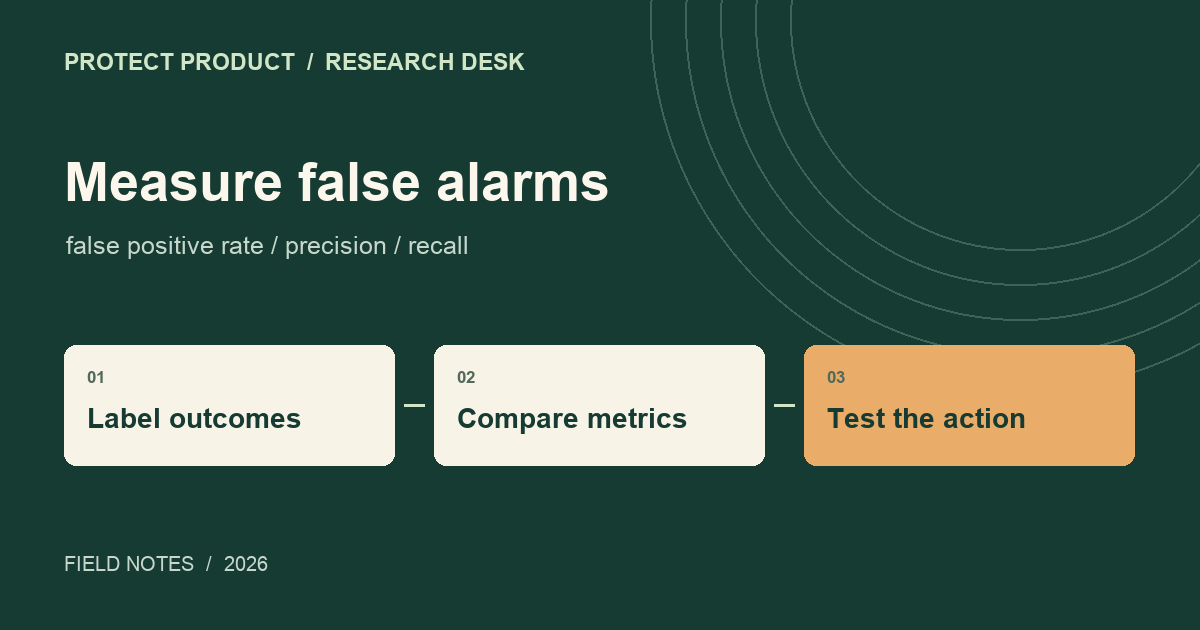
In brief: Measure false alarms on legitimate activity, inspect the evidence behind them and test narrower actions before changing the decision for everyone.
What is a false positive in fraud detection?
A false positive occurs when a legitimate event is classified as fraudulent. It may lead to an unnecessary review, verification step or block. The effect depends on the action: an analyst reviewing a harmless login has a different cost from a legitimate buyer being unable to complete checkout.
Separate the detection result from the action it triggered. Record whether the user was scored, challenged, held or blocked, and whether they recovered. An alert count alone cannot show the cost to customers.
False positive rate is not the share of bad alerts
Google's classification guide defines false positive rate using all actual negatives. In a fraud evaluation, those are the legitimate events. Precision instead uses all positive predictions. Always name the denominator when presenting either metric.
| Metric | Calculation | Question |
|---|---|---|
| False positive rate | FP / (FP + TN) | What share of legitimate events was flagged? |
| Precision | TP / (TP + FP) | What share of alerts was confirmed abuse? |
| Recall | TP / (TP + FN) | What share of known abusive events was caught? |
Consider a hypothetical labeled cohort: 9,900 legitimate events and 100 abusive events. A tool flags 99 legitimate events and 80 abusive events. Its false positive rate is 99 divided by 9,900, or 1 percent. Precision is 80 divided by 179, about 44.7 percent. Recall is 80 divided by 100, or 80 percent. None of those values can substitute for the others.
Establish labels you can defend
Use confirmed abuse and confirmed legitimate activity where available. Keep unresolved cases in a separate group. A payment without a dispute today may still receive a later outcome; a signup can also look clean until repeated benefit claims appear. Decide when labels are mature enough for the use case.
Sample both flagged and unflagged activity. If analysts inspect only alerts, you can learn about alert quality, but you cannot estimate missed fraud or the false positive rate across all legitimate events. Document sampling rules and exclusions alongside the result.
Find the segment that creates the error
Break down mistakes by journey, region, device, customer tenure and signal family. Shared offices, mobile carrier networks and privacy services can explain a network flag without proving account abuse. Review those cases with account history and device continuity before changing a decision.
Look at support cases as well as dashboards. Can a genuine customer complete another verification step? Are repeated challenges concentrated on a particular app version? A recovery rate and time-to-resolution can reveal customer harm that an aggregate alert metric hides.
Change one decision and test its trade-off
Begin in monitoring mode when the integration supports it. Compare the existing decision with one proposed threshold or rule change on the same labeled cohort. Keep missed abuse, analyst workload and customer completion visible alongside false alarms.
A practical action ladder can allow ordinary activity, use additional verification for uncertainty and reserve stronger restrictions for corroborated abuse. It is a design choice for your application, rather than a universal threshold. Stripe's rules guide describes backtesting rule impact before activation; use the same principle wherever your tooling supports historical evaluation.
Keep a rollback and review schedule
Write down the old decision, the new decision and the condition that triggers rollback. After rollout, compare customer completion, confirmed abuse, challenge success and review time. Recheck when traffic sources, customer regions or product flows change.
Use the parallel test guide for the evaluation setup. If the problem starts before accounts exist, read the bot mitigation comparison to check whether another layer should own that action.
FAQ
What is the difference between false positive rate and precision?
False positive rate is the fraction of legitimate events flagged: FP divided by FP plus TN. Precision is the fraction of alerts confirmed as abuse: TP divided by TP plus FP.
Does a lower false positive rate always mean a better fraud tool?
No. A tool can reduce false alarms by missing more abuse. Compare recall, customer completion, investigation work and the action taken on the same representative cohort.
Can I measure false positives by reviewing alerts only?
Alert reviews can estimate alert quality in the reviewed sample. Measuring false positive rate across legitimate activity requires a suitable denominator and sampling beyond alerts.
Sources
Continue the evaluation
Compare the 20-product scorecard, examine the rubric, and read full vendor reviews before committing to a shortlist.