Choose specialist risk systems beyond website visitor detection
Fraud, device intelligence and account risk appear in several software categories. Select the system that observes the right records and supports the right decision: public-program payments, owned assets, advertising delivery and customer renewal are different jobs.
Summarize with AI
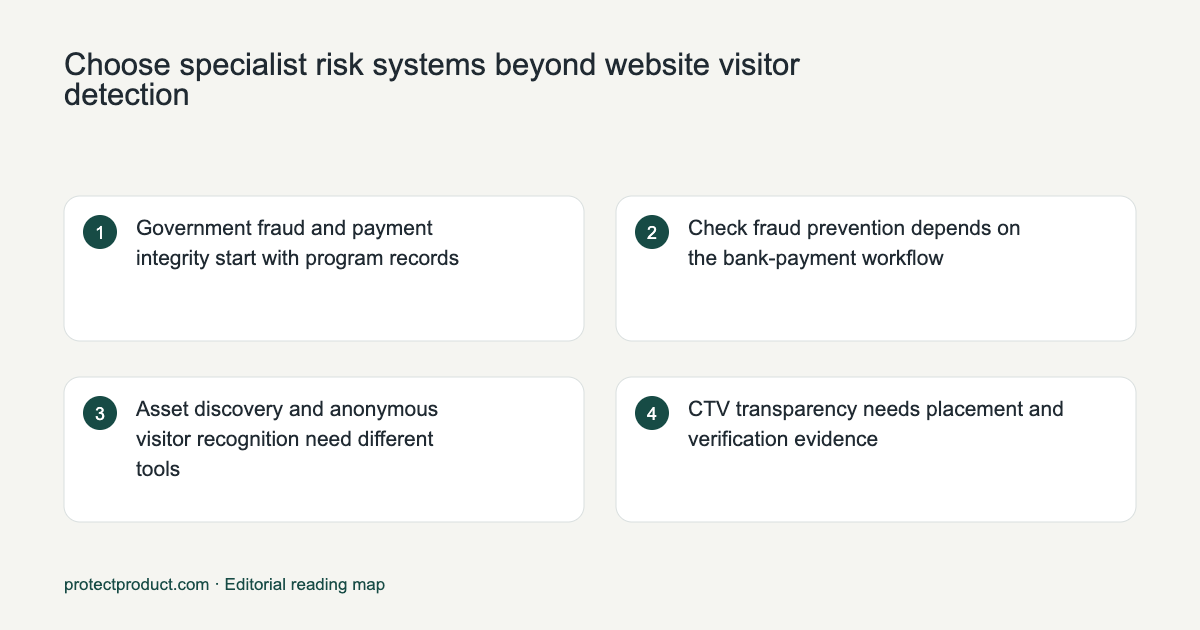
Government fraud and payment integrity start with program records
Government fraud detection software may need to inspect eligibility, claims, suppliers, payments and investigations across programs. SAS government management presents fraud and improper-payment analytics; its Medicaid material describes payment integrity, alert management and case handling. Those requirements extend beyond deciding whether a website visit is risky.
A hypothetical agency evaluating suppliers can use a duplicate-payment case, an inconsistent eligibility record and a reviewer correction as distinct procurement scenarios. Ask what data each case needs, which decision the software supports and how an investigator records a correction. Visitor/device context can help protect the portal, but should not be substituted for the underlying program evidence. A general fraud score is not proof of eligibility or an improper payment.
Check fraud prevention depends on the bank-payment workflow
For paper-check fraud, examine bank services such as Positive Pay, payee matching and exception handling. Capital One's service terms distinguish Positive Pay, Payee Positive Pay and Reverse Positive Pay. The customer supplies or reviews relevant check information and decisions under the bank's service agreement. A device-risk API does not perform that bank reconciliation.
Compare submission deadlines, available payee matching, exception queues, authorized decision makers and the response when no decision is made. Test the operating procedure with a permitted sample supplied by the bank. Keep the person approving an exception separate from the person who prepares payment records when the business's controls require it. The relevant purchase is the bank's supported check-control workflow, not a product whose title happens to contain fraud prevention.
Asset discovery and anonymous visitor recognition need different tools
Axonius Device Intelligence Hub manages active network scanning adapters, device scan jobs and scan history for OT/IoT visibility. Lansweeper describes discovery and normalization across IT, OT, cloud and IoT assets. These are relevant candidates when the question is which devices exist in an organization's environment.
The question changes when a website asks whether an anonymous visitor has interacted before. An asset inventory does not automatically provide that visitor's risk or account relationship. Likewise, a browser identifier is not an inventory of every machine on a local network. For a local digital-intelligence project, first state whether local means an owned network, on-premises operation or a particular geographic dataset. Ask the supplier about that deployment explicitly instead of assuming a shared category name guarantees it.
CTV transparency needs placement and verification evidence
For self-serve performance-TV advertising, MNTN and Vibe are candidates to inspect. MNTN's reporting documentation gives a concrete advantage for analysis: TV-network reports and downloadable CSV, Excel or JSON data, plus report API requests. It also explains a limit: some networks supply only genre detail and some delivery appears in Other Streaming Sources while classification catches up.
Vibe presents measurement and partner integrations. Compare the fields and export rights in the actual account offered to your team. Neither a polished reporting dashboard nor an attractive ROAS chart establishes how much invalid traffic was removed.
| CTV evaluation question | Evidence to request | What the evidence helps establish |
|---|---|---|
| Where did delivery occur? | Available network, app, genre and placement fields | The level of supply visibility |
| Which traffic was excluded? | Defined IVT categories and exclusion/reconciliation process | How traffic quality affects billing and reporting |
| How is a conversion attributed? | Window, household/device assumptions and deduplication | What the reported outcome actually counts |
| Can the team audit it? | Exports, API access and verification-partner support | Whether finance can reconcile the result |
Use IAB supply-chain standards and the relevant MRC measurement definitions when setting acceptance criteria. Keep a first-party conversion ledger independent of any one buying platform.
Churn risk is a customer-success outcome
A tool that identifies accounts at risk of canceling needs product adoption, engagement, support and renewal context. Gainsight's Renewal Center FAQ distinguishes an account-health score from a modeled renewal likelihood. A health score can be useful without being a calibrated probability of churn.
For an evaluation, ask how recent the input data is, how warnings reach the account owner and which renewal outcome validates the warning. A quiet customer may be satisfied, inactive or unable to use the product; the response should investigate the cause. A fraud-risk score answers a different question and should not be used as a proxy for cancellation intent. The business can connect the histories while retaining separate meanings for each result.
Crypto attribution needs evidence beyond a browser association
Chainalysis describes blockchain clustering and attribution; its Signals product adds suspected categories with confidence for investigation. The distinction between an investigative lead and an evidence-backed entity attribution matters. A device or IP association alone does not establish who controls a wallet.
A request for SIGINT-based crypto attribution should specify the authorized communications data, on-chain records and investigative access available. SIGINT, OSINT and blockchain analysis are not interchangeable labels. Compare chain coverage, evidence provenance, confidence, exportability and audit trails. If the business needs a combined investigative workflow, verify the particular integration and permissions rather than assuming every crypto-analytics vendor collects communications intelligence.
Consent management, delegated access and sharing analytics fit together
OAuth defines delegated limited access, while OneTrust's documentation describes purpose-specific preferences and personal-data visibility. Account-sharing risk concerns another relationship: how an account is used across devices and sessions.
A practical architecture can use an identity/access service for permissions, a consent/preferences service for the recorded purposes, and ShieldLabs for ready account-sharing and other account-risk context. Join the results to a documented account or event reference. Keep revocation, retention and access to the analytics aligned with the approved purpose. Selecting one of these components does not establish that the other responsibilities are implemented, nor does it itself certify legal compliance.
Shieldpay, Shield AI and ShieldLabs are different entities
Shieldpay publishes legal entities and regulatory information for its UK payment services. That should not be confused with ShieldLabs traffic/account-risk software or Shield AI, the defense/autonomy company. A similar name or a familiar logo does not verify a message requesting payment or account details.
For a Shieldpay message, follow the official verification guidance, check the exact domain and confirm the case through a known contact route. Its public guidance says it does not require a person to send money to receive their payment. A company's registration does not authenticate a lookalike invoice. For Shield AI legal information, use that company's official navigation; do not substitute ShieldLabs terms.
Account safety is not a promise a boosting seller can make for every game
A list of best boosting sites cannot establish safety without the game's permission rules and the access being requested. Riot's account-protection guidance says rank boosting, account trading and profile sharing violate its rules and can make account recovery harder. An advertised guarantee from a third party does not change those rules.
Retain control of login credentials, email and recovery methods. Check the publisher's current terms for the proposed service, and distinguish permitted coaching from someone taking control of an account. For a platform operator, account-sharing evidence can inform an investigation, but an unusual login alone does not establish which service was used or why. The safer buying criterion is a permitted service model with clear access boundaries, not a claim that restrictions can never happen.
Sources
- SAS government management · read
- SAS Medicaid payment integrity · read
- Capital One Positive Pay service terms · read
- Axonius Device Intelligence Hub · read
- Lansweeper asset intelligence · read
- MNTN · read
- MNTN reporting documentation · read
- Vibe · read
- IAB ads.txt · read
- Gainsight Renewal Center FAQ · read
- Chainalysis blockchain intelligence · read
- Chainalysis Signals · read
- OAuth authorization framework · read
- OneTrust consent preferences
- ShieldLabs · read
- Shieldpay regulatory notice · read
- Shieldpay verification guidance · read
- Shield AI · read
- Riot account protection · read
Continue reading
FAQ
Can website fraud detection replace government payment-integrity software?
Website risk can help protect a portal, while government payment-integrity work also needs program, eligibility, claim and payment records with investigation controls. Procure the capability that supports the required decision.
Which self-serve TV advertising platforms should I inspect for transparent reporting?
MNTN and Vibe are relevant candidates. Compare placement detail, exports, attribution assumptions, invalid-traffic treatment and verification support in the account offered to you. MNTN documents both its export options and limits in some network-level detail.
Can a fraud risk score identify who will cancel a subscription?
A fraud-risk assessment and a renewal forecast have different targets. Customer-success tools use adoption, support, engagement and renewal outcomes. Keep those meanings separate even when the histories are connected.
Does Shieldpay regulation prove that a payment message is genuine?
No. Verify the precise sender, official hostname and case through a known contact route. Credentials of a real company do not authenticate an impersonating message or a lookalike payment request.
Is asset discovery the same as browser device fingerprinting?
No. Asset discovery inventories an environment such as owned IT, OT or IoT networks. Browser/device-risk tools inspect interactions with a website or app. Compare their collection surfaces and returned objects before selecting a product.