Read this article with AI
Copy the article text into your chosen tool to inspect its sources and trade-offs.
Start with a loss map
Write down where money, stock or customer trust is lost. Stolen-card orders need a payment workflow. Repeated welcome discounts need promotion eligibility. A compromised customer account needs authentication and recovery. Sending all three problems to a single “fraud score” hides which control failed.
For each loss, name the event, the evidence available before it and the team allowed to intervene. If stock leaves the warehouse before a review finishes, a dashboard alone will not prevent that shipment.
| Purchase need | Capability to evaluate | Proof to request |
|---|---|---|
| Unauthorized payments | Payment risk and authentication | Supported payment methods and decision timing |
| Compromised accounts | Session and sensitive-action controls | Login-to-order evidence and recovery flow |
| Repeated benefits | Account links and benefit ledger | Eligibility, reversals and shared-household handling |
| Disputes | Evidence workflow or contractual coverage | Covered reasons, exclusions and submission duties |
| Returns | Order and fulfillment review | Item-level records and customer resolution |
Compare products within their actual scope
Payment-provider tools can use payment-specific context and operate close to authorization. Stripe’s Radar rules documentation, for example, describes different rule actions and plan-dependent features. That is evidence of that product’s workflow, not a benchmark proving it is the best tool for every store.
An account or device-intelligence service may contribute evidence before checkout, including relationships between signups and repeated benefit claims. It does not automatically provide payment liability coverage. A managed service may include review work, but review hours, escalation rules and coverage still belong in the contract.
Use fraud vendor comparisons to build a like-for-like shortlist. Existing product reviews are starting points for scope questions; confirm the current offer with each supplier.
Separate an order decision from a payment decision
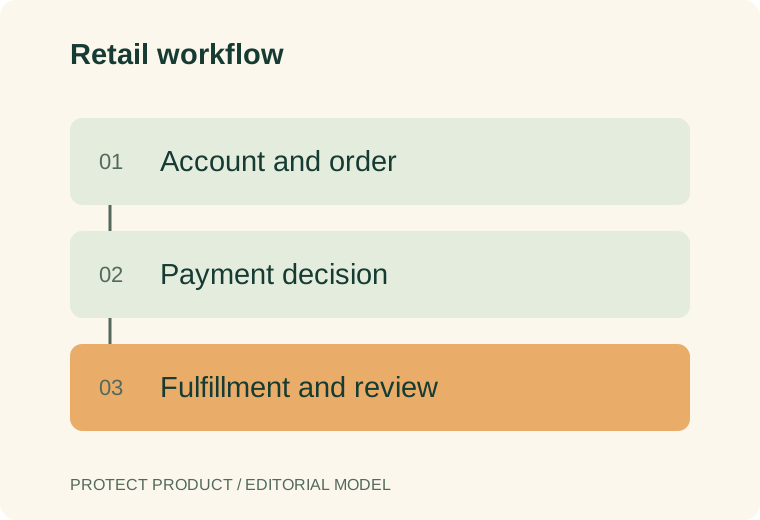
A payment can be authorized while an order remains unsuitable for fulfillment. Conversely, an issuer decline is not a merchant’s proof that the shopper is fraudulent. Keep processor status, merchant policy and shipment state as separate records.
A hypothetical retailer sells downloadable software and physical equipment. A manual-review delay may be practical for equipment that has not shipped. A digital license delivered instantly needs its own release control. The same vendor response cannot be pasted into both journeys without changing when value is delivered.
The card-testing guide covers payment-attempt abuse. Return abuse prevention covers a later decision with different evidence.
If checkout includes installment methods, use the BNPL responsibility map to separate financing approval from merchant account and fulfillment checks.
Run a pilot on a named order cohort
Choose one channel, region or product group with enough legitimate and confirmed-abuse examples to learn from. Record how cases were labeled. Pending disputes and unexplained declines should not be silently converted into confirmed fraud.
Measure accepted legitimate orders, confirmed losses, review effort and customer complaints together. Compare equivalent observation windows because disputes and returns arrive after the purchase. A faster block rate alone says little about whether the store improved.
Retain a route for reviewers to explain an override. If an existing customer is blocked, the team needs enough evidence to resolve it without asking the shopper to diagnose a device fingerprint.
Price the complete operating workflow
Ask what creates a charge: identification, API request, transaction, revenue, review or covered order. Include retries, mobile traffic, test environments, support and historical exports. The pricing-unit guide provides a worksheet for comparing different billing models.
Coverage should be reviewed separately from software fees. Identify the covered event, claim deadline, documentation needed and exclusions. Avoid putting a “guaranteed” label in a comparison table until the actual agreement supports that wording.
Turn the evaluation into a purchase decision
Finish with a short record: the loss addressed, the intervention point, pilot findings, remaining unknowns and operating owner. A tool that fits a large marketplace’s review team may be too demanding for a small store. A simple integration may also leave a specific high-value workflow uncovered.
Buy the smallest scope that solves the measured problem and can be operated reliably. Expand after the store can show what changed in losses and legitimate customer outcomes.
Examples for a retail shortlist
Use these current public scopes to choose whom to evaluate. This list is not a measured ranking or a statement that the commercial packages are equivalent.
| Example | Relevant public scope | Key question |
|---|---|---|
| Stripe Radar | Rules near the payment decision | Does the plan and payment method support the required action? |
| Sift | Payment and account products | Which product protects this order journey and who operates review? |
| Signifyd | Commerce products and guarantee-related offerings | What does the actual agreement cover, require and exclude? |
Bring a completed legitimate order, a confirmed unauthorized order and an unresolved service complaint to each evaluation. Ask for the evidence and supported action at the point where the store can still intervene.
FAQ
What are the best ecommerce fraud prevention tools?
The right shortlist depends on payment, account, promotion and fulfillment needs. Compare products against the same decision and current contract rather than an unsupported universal ranking.
Does payment authorization prove an order is safe?
No. Authorization, account ownership, promotion eligibility and fulfillment risk are separate decisions.
Should a small store buy device intelligence immediately?
First identify the loss and gaps in existing controls. Device evidence is useful when it answers a specific account or order question the store can act on.
Sources
Editorial basis: primary-source documentation and a practical evaluation framework. Examples are hypothetical unless explicitly identified otherwise. This article does not report an independent vendor benchmark.
For evaluation standards and corrections, see our methodology and contact page.