Read this article with AI
Copy the article text into your chosen tool to inspect its sources and trade-offs.
Recognize the incident without reproducing it
Stripe’s card-testing guidance identifies spikes in failed or blocked payment activity as a warning sign. The relevant question for a merchant is whether its payment flow is being used for repeated unauthorized validation, not simply whether traffic increased.
Inspect the timing, affected endpoints, customer and order links, and processor outcomes. A sale can raise traffic and issuer declines legitimately. An integration defect can also produce repeated failures. Establish which explanation fits the evidence before applying a broad restriction.
Keep investigation material within approved access. The defense team does not need raw card details in application logs to understand an attempt pattern.
Map all payment entry points
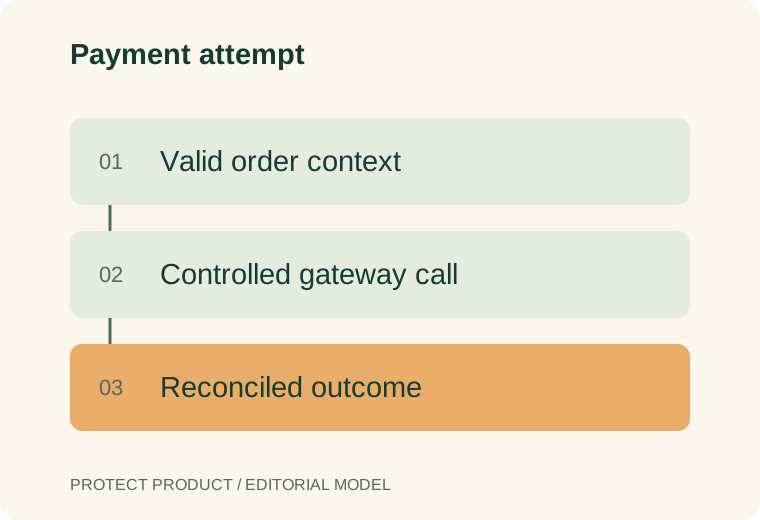
The visible checkout page is only one route to a payment service. Saved-card setup, mobile checkout, subscription changes and platform plugins may use different code paths. Inventory the paths your business actually operates and who maintains them.
| Entry point | Control question | Incident evidence |
|---|---|---|
| New checkout | Is this request tied to a valid order? | Order, session and gateway event IDs |
| Card setup | Is this account allowed to add this method? | Account state and attempt history |
| Retry | Is this a retry of the same business action? | Stable operation and idempotency keys |
| Mobile purchase | Does the server enforce the same policy? | App version and server outcome |
| Plugin integration | Who owns updates and emergency changes? | Version, settings and provider support case |
Add controls before expensive attempts
Use the payment provider’s recommended integration and follow its current guidance. Add your own server-side checks where your application owns the order or account boundary. A client-side button disable is a usability feature; it cannot enforce the server’s rules.
Rate controls should consider the action and authenticated context, with carefully chosen network or device signals where available. A shared office network should not inherit an unlimited block because one checkout failed. See IP fraud scores for the limits of network reputation.
If a challenge is used, validate its result on the server and bind it to the intended flow. CAPTCHA alternatives explains the difference between a challenge result and account authorization.
Keep retries and duplicate charges apart
A timeout can leave the application uncertain whether a provider processed a request. Define a retry policy around a stable business operation and the provider’s documented idempotency behavior. Stripe’s idempotency reference is one example; another provider may use different rules.
In a hypothetical checkout, one shopper presses pay again after a network interruption. The service should reconcile the existing operation before creating an unrelated attempt. That differs from repeated attempts across many unrelated orders. Both may look like “more requests” in a raw chart.
Retain an unknown state until reconciliation finishes. Do not label an unobserved result successful, declined or fraudulent merely to keep a dashboard tidy.
Respond with the payment team
During an incident, assign an owner for application controls and a contact for the gateway. Review provider alerts, maintain a legitimate checkout path and record the exact time of each intervention. Do not expose detailed risk reasons in public error messages.
Review payments that slipped through using your provider’s incident and refund process. The decision should use actual transaction evidence and the payment team’s authority; an IP label alone is not sufficient grounds to cancel every nearby order.
The chargeback guide explains why prevention and later dispute handling need different records.
Check whether the response improved checkout
Compare attempts, confirmed abusive activity, completed legitimate purchases and support complaints over matching intervals. Separate payment failures caused by the integration from customer and issuer outcomes. Check every active channel after the emergency change.
Close the incident with a code or configuration change, an operating owner and evidence that the affected entry point was covered. A gateway dashboard is useful, but prevention depends on the full request path that reaches it.
FAQ
Is every small payment card testing?
No. Use attempt patterns, account and order context, and provider evidence. Price alone cannot establish intent.
Can an IP block solve card testing?
It may help with a specific incident, but shared addresses and changing traffic paths make it an incomplete control.
Does a payment gateway protect my own API automatically?
Confirm the integration boundary. Your service still owns order validity, account permissions and any routes that call the gateway.
Sources
Editorial basis: primary-source documentation and a practical evaluation framework. Examples are hypothetical unless explicitly identified otherwise. This article does not report an independent vendor benchmark.
For evaluation standards and corrections, see our methodology and contact page.