Read this article with AI
Copy the article text into your chosen tool to inspect its sources and trade-offs.
Separate demand management from eligibility
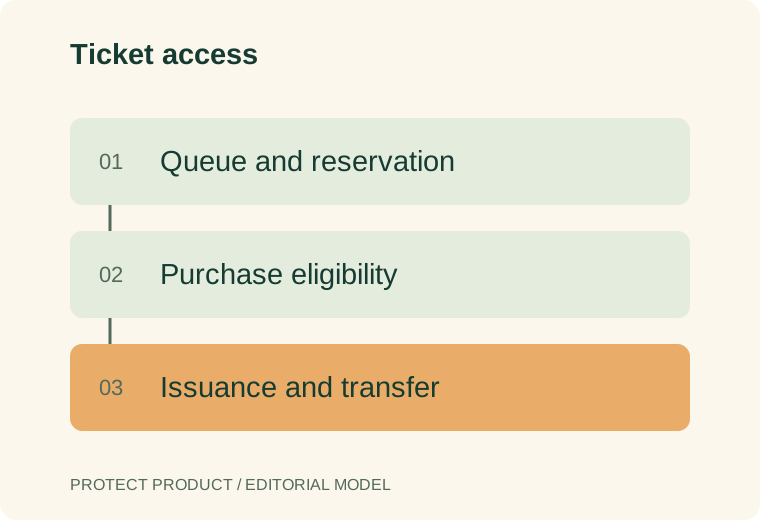
A queue controls access to a busy service. A purchase limit defines what an eligible buyer may obtain. A ticket transfer rule governs a later action. Each needs its own server-enforced state and source of authority.
A customer reaching the front of a queue should not automatically receive permission to exceed the order limit. Nor should a completed purchase permanently authorize every future transfer. Keep the queue session, order and ticket records linked without collapsing their roles.
| Boundary | Question | State to enforce |
|---|---|---|
| Queue admission | Is this entry valid for this sale? | Queue/session rules |
| Inventory hold | Is capacity reserved and when does it expire? | Reservation ID and expiry |
| Purchase | Is the buyer eligible for this quantity? | Server-side order entitlement |
| Ticket issuance | Has the order reached the required final state? | Payment and issuance references |
| Transfer | Is this transfer allowed under the event policy? | Current owner and transfer record |
Apply limits to the entity your policy names
If a rule limits tickets per account, enforce it against the account record. If the policy names a verified buyer or organization, establish that entity through the approved process. An IP address or fingerprint alone cannot reliably define a person.
Shared households and assisted purchases need explicit handling. A hypothetical family uses one computer for several permitted buyers. A blanket device ban could reject them while failing to resolve the underlying eligibility question.
Read multi-accounting detection tools for account relationships and device fingerprinting techniques for measurement limits.
Place automation controls where they protect capacity
Inspect whether excessive traffic affects browsing, queue entry, holds or purchase operations. An edge service can help manage request load, while application controls enforce ticket and order rules. Evaluate both at their own boundaries.
Use approved bot and challenge integrations with server verification where required. Preserve an accessible customer path when a challenge cannot complete. The CAPTCHA alternatives guide explains why completing a challenge does not prove eligibility to buy.
OWASP’s automated-threat framework is useful for categorizing misuse of valid application features. It does not establish an event’s legal resale policy or the intent of every automated client.
Keep reservation and payment failures recoverable
Time-limited holds need clear expiry and release behavior. Payment retries should reconcile with the existing order so a timeout does not issue duplicate tickets or leave stock reserved indefinitely.
Test an interrupted purchase in an authorized staging environment. Confirm whether the queue position, hold, payment and issued ticket end in coherent states. Customer support needs to identify which step failed without asking the buyer to retry an unknown payment repeatedly.
Use the payment gateway guide for attempt controls and reconciliation principles.
Review transfers under published rules
Specify allowed gifting, resale or reassignment for the event and market. Keep the current owner and transfer history authoritative on the server. A screenshot or client-side assertion should not independently update ownership.
For suspected policy abuse, retain the relevant order, eligibility and transfer evidence. Apply proportionate review and an appeal route. Do not present every resale listing as proof that a bot bypassed the initial sale.
Evaluate buyer access as well as abuse reduction
Measure successful legitimate purchases, unresolved holds, duplicate charges, customer complaints and confirmed policy violations. High traffic rejection during a popular sale can reflect demand as well as abuse.
Run a full lifecycle pilot from queue entry to a permitted transfer. A useful system must preserve the rules and inventory across the entire journey, including interruptions, shared-device cases and support corrections.
FAQ
Does every scalper use bots?
No. Automation, purchase eligibility and resale policy are separate questions. Investigate the actual conduct and event rules.
Can one device equal one ticket buyer?
Not reliably. Devices can be shared or changed. Enforce the policy against the entity it actually names.
Does queue access guarantee purchase eligibility?
No. The application must still check order limits, inventory and other applicable purchase requirements.
Sources
Editorial basis: primary-source documentation and a practical evaluation framework. Examples are hypothetical unless explicitly identified otherwise. This article does not report an independent vendor benchmark.
For evaluation standards and corrections, see our methodology and contact page.