Read this article with AI
Copy the article text into your chosen tool to inspect its sources and trade-offs.
Begin with the dispute reason
Stripe’s dispute lifecycle explains the payment-provider process when a cardholder disputes a payment through their bank. A merchant’s internal “fraud” label does not replace the reason, deadlines or evidence requirements of that process.
Use the actual case category. A missing delivery needs fulfillment evidence. A subscription cancellation complaint needs the relevant agreement and cancellation history. An unauthorized-payment claim raises a different account and payment question. A familiar browser alone does not resolve any of them.
Terms such as “friendly fraud” can hide this distinction. Record what is known about a case rather than treating all customer disputes as intentional deception.
Preserve useful events before there is a dispute
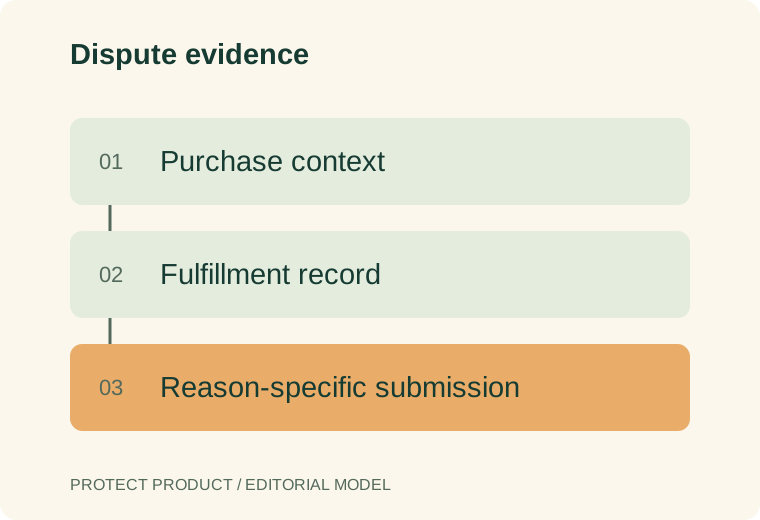
Collect records needed to explain the purchase and service delivery, under the business’s retention and access rules. This can include the order, authenticated account, policy version, payment-provider reference and fulfillment status. Keep raw secrets and sensitive data you do not need out of the evidence store.
| Record | Question it can help answer | What it cannot establish alone |
|---|---|---|
| Order and payment reference | Which purchase is disputed? | Who controlled the account |
| Account activity | What did the authenticated session do? | That its owner authorized every action |
| Device association | Was an environment seen before? | A unique person or payment consent |
| Delivery record | What was delivered and when? | That every service expectation was met |
| Support history | Was an issue raised or resolved? | That the payment network must accept the case |
Use device context at the decision point
Device evidence may connect an order to prior account activity or highlight a changed environment. Interpret it with the event’s timing and collection settings. A customer replacing a phone and an intruder changing a delivery address require different investigation.
For a hypothetical digital service, a purchase followed immediately by account recovery and a new payout destination deserves review of the sequence. The useful evidence is the sequence and authority of the changes, with device context attached. “Same device” or “new device” is an incomplete verdict.
Read account takeover signals for sensitive actions and device fingerprinting techniques for identification limits.
Keep prevention rules distinct from dispute evidence
A pre-payment rule can hold an order or request a supported verification step. A dispute submission explains an already completed transaction. Evidence useful for one task may be insufficient or unsuitable for the other.
Ask your processor which evidence is accepted for the specific dispute. Avoid exporting a full internal customer profile by default. A concise, accurate submission with the required fields is easier to review than a dump of unrelated telemetry.
Track whether a submission was accepted, won, lost or remained unresolved. A submitted case is not a recovered payment.
Read guarantee terms as a separate product
Some vendors offer contractual coverage or managed disputes. Confirm covered reasons, eligible channels, exclusions, review obligations and deadlines. The words “chargeback protection” do not tell you whether a particular order qualifies.
Compare software cost and coverage cost separately in the pricing worksheet. Do not calculate savings as though every prevented-looking event would have become a chargeback, or every covered order would automatically be reimbursed.
Measure losses and legitimate customer outcomes
Use mature order cohorts when comparing disputes because cases arrive later than checkout. Keep gross disputed value, final loss, refunds and recovered funds separate. Include review effort and false declines in the evaluation.
If a new rule reduces chargebacks while rejecting valuable legitimate customers, the result needs a fuller business review. The false-positive guide explains the denominators that make this comparison meaningful.
Start with one dispute reason and one purchase path. Improve evidence collection there before claiming a device tool solves all chargeback fraud.
FAQ
Can a fingerprint prove friendly fraud?
No. It is contextual evidence about an environment, not proof of a person’s intent or consent.
Are all chargebacks caused by stolen cards?
No. Disputes can involve service, delivery, subscription and other issues. Use the actual reason and evidence requirements.
Does a vendor guarantee replace merchant records?
Not necessarily. The agreement can require specific records, timely decisions and claim submissions. Check the current terms.
Sources
Editorial basis: primary-source documentation and a practical evaluation framework. Examples are hypothetical unless explicitly identified otherwise. This article does not report an independent vendor benchmark.
For evaluation standards and corrections, see our methodology and contact page.