Read this article with AI
Copy the article text into your chosen tool to inspect its sources and trade-offs.
Classify the request before scoring the customer
A return, a cancellation, a refund and a payment dispute are different events. A customer can request a refund without returning a physical item, especially for services. A payment may also need to be canceled before completion rather than refunded afterward.
Stripe’s refunds documentation describes provider-specific payment handling. A store’s item-return process needs additional inventory, inspection and policy records. Do not use the payment status as a substitute for the warehouse result.
Create categories that staff can apply consistently: delivery problem, wrong item, product fault, ordinary policy return and suspected misuse. Allow an unknown category while facts are checked.
Review at the item level
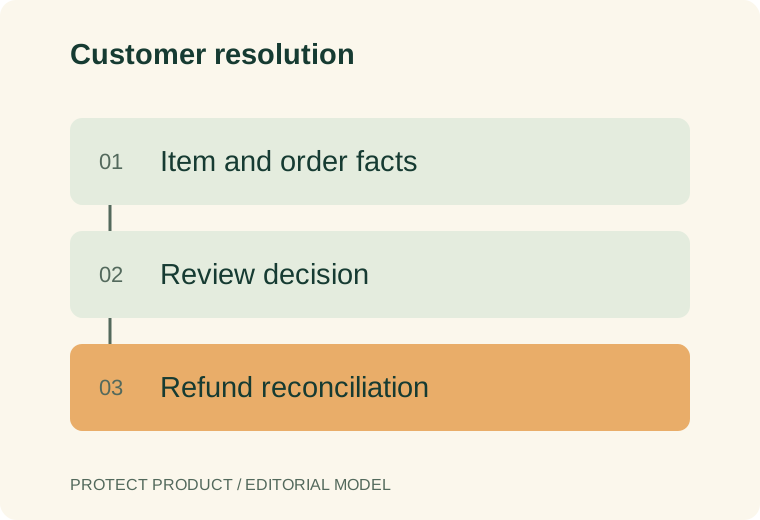
An order may contain items with different delivery dates and outcomes. Tie the request to the relevant line item, quantity and fulfillment record. A customer should not lose a valid refund on one item because another item is still under review.
| Evidence | Operational use | Review limit |
|---|---|---|
| Order and item ID | Match the request to a purchase | Does not establish product condition |
| Shipment or delivery event | Reconstruct the fulfillment timeline | May need investigation when disputed |
| Inspection result | Record what was received | Keep method and reviewer visible |
| Published policy version | Explain the applicable process | Check customer rights and exceptions separately |
| Account history | Identify repeated patterns | Rate alone does not establish dishonesty |
Use account relationships carefully
Related accounts can help explain repeated claims, but families, workplaces and shared devices are ordinary commerce contexts. Keep the underlying evidence and confidence available to the reviewer. Avoid an irreversible “fraud household” label created from a single network or address match.
The multi-accounting guide explains how to evaluate links. Synthetic identity fraud covers a different question: whether a claimed identity has been fabricated. Neither question replaces checking the actual order.
A hypothetical household has two customers using the same tablet. One received a damaged item. A relationship signal may connect their records, but the damage claim should still be assessed on its own facts.
Build a review and resolution path
Route clear, low-risk requests through the normal customer process. Send uncertain cases to a reviewer with the needed order, support and fulfillment context. Set an owner and escalation time so “under review” does not become an indefinite holding state.
Record why a reviewer approved, partially approved or declined the request. Give customer support a clear explanation and route for corrected evidence. Do not expose internal security signals or accuse the customer based on an opaque score.
Have the appropriate business or legal owner review policy and regional obligations. This article proposes an operating workflow; it does not define a store’s legal right to refuse a return.
Reconcile refunds and inventory separately
After approval, track the payment-provider action through its final state. A queued refund is not the same as completed repayment. Reconcile duplicate requests against the original operation so an interrupted support session cannot accidentally cause two refunds.
Inventory reconciliation has its own outcome: received, inspected, restocked, written off or still missing. Linking these states makes financial reporting clearer than one “returned” flag used for every step.
For a dispute that has already reached the payment network, use the chargeback workflow as well. Avoid creating conflicting customer and processor responses in separate teams.
Evaluate policy quality alongside loss
Measure confirmed misuse, refund errors, time to resolution and upheld customer appeals. Compare similar product groups and return windows. A clothing retailer’s return pattern should not be judged against a downloadable-software store without accounting for the difference.
Use a sample of reviewed cases to find unclear policy language and missing fulfillment evidence. Fix those gaps before tightening a risk threshold. A well-documented decision is more useful than a high block count that support cannot explain.
FAQ
Does a high return rate prove fraud?
No. Product fit, quality, shipping and customer mix can affect returns. Investigate the order and pattern before assigning intent.
Can device intelligence decide a refund request?
It can support a review, but it cannot inspect the product, establish delivery facts or determine customer rights.
Should refunds and returns use the same status?
Keep them linked but separate. Inventory handling and payment repayment can finish at different times or have different outcomes.
Sources
Editorial basis: primary-source documentation and a practical evaluation framework. Examples are hypothetical unless explicitly identified otherwise. This article does not report an independent vendor benchmark.
For evaluation standards and corrections, see our methodology and contact page.