Read this article with AI
Copy the article text into your chosen tool to inspect its sources and trade-offs.
Understand the payment path you actually use
Stripe’s buy now, pay later documentation shows how supported methods differ by integration and transaction features. A merchant should check the exact method, customer market and purchase flow instead of assuming every installment product behaves the same way.
Draw the path from cart to provider interaction, final payment status and fulfillment. Mark where the shopper leaves your site and which server event confirms the outcome. A return to the browser page is not, by itself, a sufficient fulfillment instruction.
Keep provider-specific requirements next to the integration. A generic “BNPL approved” field can hide statuses that require different operational handling.
Assign ownership before adding signals
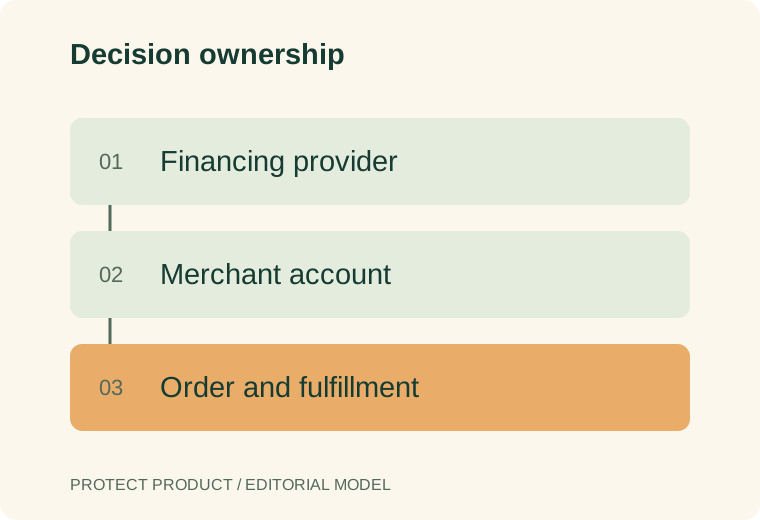
Use the contract and provider guidance to determine which party performs identity checks, underwriting, customer collections, refunds and dispute handling. Do not infer liability from the fact that a provider showed an installment offer.
| Decision | Question to settle | Useful merchant evidence |
|---|---|---|
| Credit eligibility | Who evaluates and approves the loan? | Provider result and method reference |
| Account access | Is this shopper authorized in our product? | Authentication and recovery history |
| Order acceptance | Does the order satisfy store policy? | Items, account and purchase history |
| Fulfillment | Has the required payment state arrived? | Verified server event and stock state |
| Refund | Which system initiates and confirms it? | Item resolution and provider outcome |
This division lets the merchant evaluate a device or account service against a real gap rather than purchase duplicate checks without a clear owner.
Review account takeover separately from credit risk
A shopper may access a merchant account without permission even when the installment provider has its own controls. Watch changes to contact details, delivery destinations and recovery settings around the order. Use a supported verification step for sensitive changes where your business can enforce it.
The account takeover guide covers account-defense scope. Synthetic identity fraud addresses fabricated identity claims, which cannot be settled by a familiar device identifier alone.
Do not treat a credit decline as confirmed account fraud. It is a different decision, and the merchant may not receive the evidence needed to explain it.
Reconcile payment and fulfillment events
A hypothetical retailer receives a browser return from a provider while the server has not received a final status. It should look up or await the authoritative payment event according to the integration contract. Shipping merely because the browser displays success creates a gap in the decision path.
Deduplicate incoming events and apply state changes safely. Repeated delivery of a legitimate provider event should not create multiple shipments or refunds. Preserve a pending state while the outcome is unknown and show support what the customer is waiting for.
Keep refund handling connected to the order
Partial returns can affect only part of the original purchase. Match items and amounts to the provider’s supported refund process. Reconcile the provider result before reporting that money has been repaid or a repayment schedule changed.
The merchant should not invent a customer’s installment balance from its own order database. Use the provider’s current documentation and support path for questions about the financing arrangement.
For the merchant’s item review, see return abuse prevention. Keep service complaints and suspected intentional misuse distinguishable.
Evaluate an added tool against merchant outcomes
Measure confirmed account compromise, order loss, review workload, fulfillment errors and legitimate customer friction. Use mature cohorts and keep outcomes by payment method where responsibilities differ.
Ask a prospective supplier which events its SDK observes, which platforms it supports and what its result means. A browser risk service may support an account decision without replacing the BNPL provider or covering a loss. Record that boundary in the purchase recommendation.
FAQ
Does BNPL approval mean the merchant account is secure?
No. Payment or financing decisions do not automatically prove authority to access a separate merchant account.
Can a device fingerprint perform credit underwriting?
A device observation is not a credit assessment or verified identity. The provider’s underwriting process has a separate scope.
Are all BNPL fraud losses the merchant’s responsibility?
Responsibility depends on the method, agreement and event. Verify current terms rather than assuming universal liability rules.
Sources
Editorial basis: primary-source documentation and a practical evaluation framework. Examples are hypothetical unless explicitly identified otherwise. This article does not report an independent vendor benchmark.
For evaluation standards and corrections, see our methodology and contact page.