Read this article with AI
Copy the article text into your chosen tool to inspect its sources and trade-offs.
Distinguish the discount from the claimant
A promotion code can identify a campaign without uniquely identifying a person. A code may intentionally be available to many customers. The application still needs to check whether a particular purchase qualifies for its terms.
Stripe’s coupon documentation distinguishes the discount from the customer-facing promotion code and describes configurable restrictions. Those product controls can enforce aspects of an offer, while the business may still need its own eligibility history and account context.
Write down whether the rule concerns first purchase, product, minimum basket, customer group, campaign period or prior participation. Do not replace that detail with a broad label such as “risky coupon user.”
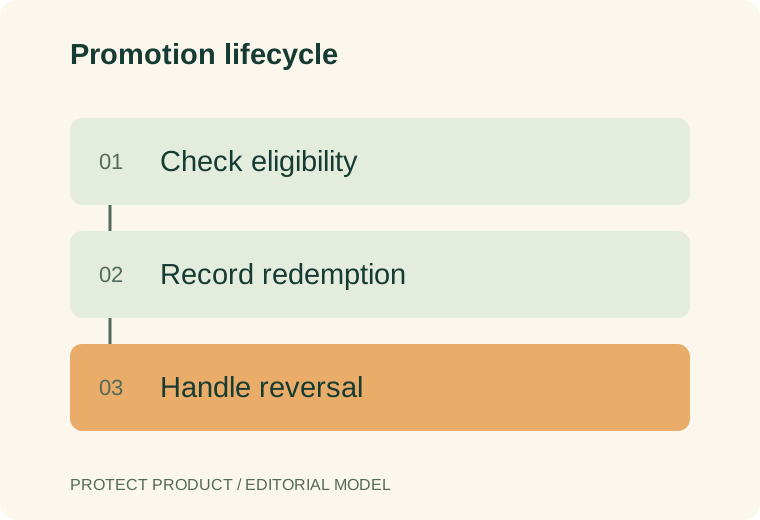
Keep a promotion claim record
| Record | Purpose |
|---|---|
| Campaign and terms version | Establishes which offer applied |
| Claimant and eligible entity | Connects the rule to the customer model |
| Purchase and redemption reference | Makes the benefit traceable |
| Qualification and grant state | Separates a request from an issued discount |
| Refund or reversal linkage | Explains what changes after the purchase |
Decide whether a failed checkout consumes a redemption and how a retry is handled. The customer should not receive a second discount or lose a valid entitlement because a response was delayed.
Add relationship evidence where the rule needs it
If an offer is limited to one eligible customer, repeated accounts may matter. Device or network observations can help identify relationships, but a household, workplace or business team may share an environment legitimately.
For a hypothetical retailer, an offer could be restricted to a customer’s first qualifying order. The review should examine order and eligibility history. Automatically rejecting every purchase from a shared office connection would not implement that rule accurately.
The multi-accounting guide explains how to inspect relationships. Use the referral-fraud article when the program also pays another participant for the conversion; that reward has its own qualification state.
Control the point where value is granted
Check eligibility on the server before finalizing the benefit. The displayed basket price and backend order should agree about the applied promotion. Include alternate checkout paths, mobile clients and any customer-service grant process.
Define who can authorize a manual exception. Record whether it applies to one order, a campaign or future participation. An unrestricted override can create a much broader benefit than the support agent intended.
For subscription or trial offers, connect the promotion to the entitlement ledger rather than assuming that changing a code resets the customer’s eligibility.
An operator evaluating a wagering promotion also needs the separate iGaming bonus-abuse review. Retail coupon logic does not establish that market’s promotion or account obligations.
Plan refunds, cancellations and campaign changes
A purchase can qualify initially and later be canceled or refunded. Decide which reward or discount consequences follow and describe them in the offer where relevant. Keep reversals connected to the original order rather than treating them as unrelated account-risk events.
Test a full refund, partial refund, exchange and retry after a timeout. These cases can produce apparent duplicate or missing benefits even without abusive intent. The return-abuse guide covers the broader review workflow.
Version campaign changes. A new eligibility rule should not silently change the recorded meaning of an earlier grant. Your legal and product owners should review the terms appropriate to the market; a detector cannot establish those terms for you.
Evaluate commercial tools on the claim workflow
Ask whether the product supplies account relationships, decision rules, campaign controls or investigation tools. Confirm which part of the process remains in your application. A general risk score may be useful but does not automatically maintain the promotion ledger.
Measure granted discount value, qualified conversion, mistaken holds and review effort. Compare similar cohorts when the campaign or acquisition source changes. Lower redemption volume alone may mean the offer became harder for valid customers to use.
Keep a recovery path for ambiguous cases. Support should be able to describe the eligibility issue and the next step without exposing unnecessary device or customer information.
FAQ
Is using a shared public code abuse?
Not by itself. The important question is whether the claimant and transaction meet the published eligibility rules.
Can email verification prevent coupon abuse?
It verifies mailbox access. It does not independently establish prior purchases, customer relationships or the rule governing an offer.
Should a refunded order restore the coupon?
That depends on the campaign’s defined policy and the systems applying it. Record the rule and test refund scenarios rather than relying on an accidental platform behavior.
Sources
Editorial basis: primary-source documentation and a practical evaluation framework. Examples are hypothetical unless explicitly identified otherwise. This article does not report an independent vendor benchmark.
For evaluation standards and corrections, see our methodology and contact page.