Read this article with AI
Copy the article text into your chosen tool to inspect its sources and trade-offs.
Write a promotion rule a reviewer can apply
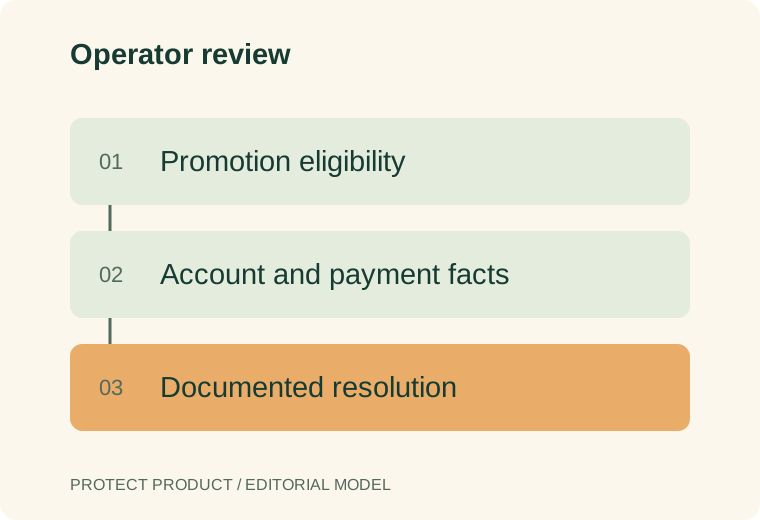
Specify who qualifies, which offer applies and what activity fulfills or invalidates its conditions. Preserve the accepted terms version with the claim. If a rule cannot be explained without referring to a hidden technical score, the operating policy needs more work.
State how the offer treats shared households, devices and payment methods. These links can be legitimate. A tool may show that two accounts share a device without proving who controls them. The accepted terms determine whether that link affects the claim.
The multi-accounting guide explains how to inspect links. The promotion-code guide covers the grant and redemption record.
Separate four investigation questions
| Question | Relevant evidence | Separate responsibility |
|---|---|---|
| Is the account eligible for this promotion? | Terms, prior claims and qualifying activity | Promotion policy |
| Are apparently separate accounts related? | Device, network and business-event context | Relationship investigation |
| Is the account owner authorizing the action? | Authentication, session and recovery evidence | Account security |
| Does a required identity check meet its defined scope? | Appropriate identity-proofing evidence | The operator’s verification process |
Do not collapse these questions into one “bonus abuse” verdict. A valid identity does not automatically settle offer eligibility. An unusual network does not independently establish that identity verification failed.
Preserve a complete benefit lifecycle
Record the offer, claimant, qualifying events, granted benefit and any subsequent correction. Keep repeated requests safe so that a delayed response cannot issue another benefit. Tie reversals to the original claim and the rule that justifies the change.
For a hypothetical operator, two related accounts might appear during a promotion. The review should inspect the accepted offer conditions and relevant activity before choosing a response. The presence of a link should not become permission to invent a new condition after the fact.
For UK-facing operations, the Gambling Commission’s guidance on varying promotions illustrates why promotional terms require their own careful review. Requirements differ by market; a fraud product does not determine the operator’s legal obligations.
Choose a tool around the missing operating layer
Some teams need account-linking evidence, others a decision workflow or payment-risk investigation. Ask which event history the service receives, what its result means and how an analyst inspects it. Confirm web and native-mobile scope rather than assuming feature parity.
The existing ShieldLabs review covers device and network context with account-abuse detections. The alternatives index includes other approaches. Choose the product that fills a named gap. Keep an owner for offer decisions and customer recovery even when a vendor supplies the signal.
Test ordinary travel, mobile connections and legitimate shared environments. A policy developed around one region or acquisition channel can behave differently elsewhere. Keep those cohorts visible in the evaluation.
Keep identity verification and withdrawal review distinct
Identity-proofing controls concern a different claim from promotion eligibility. NIST’s identity-proofing reference provides technical context for that distinction; it is not a substitute for market-specific requirements.
Define which team handles verification, account security, payment disputes and promotion questions. A customer should not be moved between unconnected reviews without an owner. Preserve the case reference and the relevant business event so that a correction can be applied to the right action.
Do not advertise a general device-risk tool as guaranteeing regulatory compliance or conclusive person identification. Scope the capability to the evidence it actually returns.
Evaluate both loss and mistaken restriction
Measure confirmed ineligible benefits, legitimate completion, review effort and correction time. Separate suspected clusters from cases that received a reasoned decision. An increasing number of flagged accounts does not establish that the operator is preventing more loss.
Inspect how policy changes, campaign mix and integration changes affect the results. Keep the offer version and observation window stable when comparing tools. Use the false-positive guide to define legitimate outcomes and the cost of mistaken restrictions.
FAQ
Does multi-accounting automatically prove bonus abuse?
No. Apply the promotion’s actual eligible-entity and participation rules to the reviewed evidence.
Can a device-risk API replace identity verification?
It evaluates a different set of observations. Confirm the defined scope of each verification and account-risk control.
Which iGaming tool is universally most accurate?
No universal ranking is established here. Compare supported events, platforms, review workflow and outcomes on a relevant controlled cohort.
Sources
Editorial basis: primary-source documentation and a practical evaluation framework. Examples are hypothetical unless explicitly identified otherwise. This article does not report an independent vendor benchmark.
For evaluation standards and corrections, see our methodology and contact page.