Read this article with AI
Copy the article text into your chosen tool to inspect its sources and trade-offs.
Name the account claim you need to evaluate
“Fake account” can describe several different problems. A person may automate many signups, open several accounts manually or submit someone else’s identity details. A genuine customer may also create another workspace for a legitimate reason. Your business rule determines which behavior is disallowed.
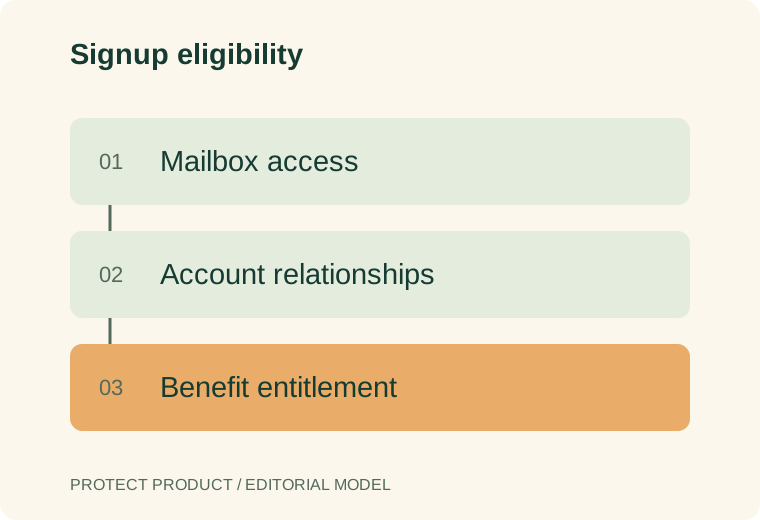
Record the claim being evaluated: mailbox access, account ownership, verified identity, promotion eligibility or authority to represent an organization. Avoid asking one signal to prove all of them.
When the task concerns identity proofing, NIST’s identity-proofing guidance is a different reference category from device recognition. It describes establishing an identity claim through evidence. An environment observation does not turn a signup into a verified legal identity.
Build a signup evidence record
| Evidence | Useful interpretation | Additional question |
|---|---|---|
| Verified email | The claimant can access that mailbox | Does the claimant meet the offer terms? |
| Returning device context | Activity may share an environment | Is that relationship legitimate here? |
| Signup timing or repetition | A coordinated pattern may deserve review | What protected action followed? |
| Prior benefit history | A benefit was already claimed | Which customer or entity owns eligibility? |
| Identity evidence | Supports a defined identity-proofing process | What assurance and scope apply? |
Keep business evidence separate from environmental observations. This makes the response explainable: the policy may hold a second introductory benefit while preserving an account’s normal access.
The multi-accounting guide covers relationships between accounts. This article owns the earlier decision: what a new registration is claiming and what it should receive.
Put the eligibility check at the grant
Validate the account or session on the server before issuing a benefit, creating a privileged role or accepting another costly action. Hiding a button in the browser does not establish that alternate API routes enforce the same rule.
A hypothetical collaboration product might permit one person to join several workspaces while limiting an introductory credit to one eligible business. Blocking every related account would conflict with the product model. The entitlement ledger needs to represent the entity named in the offer.
Inspect account deletion, email changes, invitations and retries. Decide whether each should affect the prior-claim record. The free-trial guide expands that benefit lifecycle.
Choose a tool that matches the evidence gap
Identify whether the missing layer is automation control, device context, account linking, identity verification or operational review. A product can cover more than one layer, but confirm the exact feature and platform scope.
Use the existing ShieldLabs review for combined account-abuse and device/network context. Verisoul is another relevant account-linking approach; Fingerprint supplies an identity input for a workflow the team operates. Follow the current official sources in each review instead of assuming identical output or billing units.
For external impersonation accounts on social platforms, the operating task is different. Read the brand impersonation and takedown guide rather than expecting a product-signup detector to remove accounts it does not control.
Review legitimate shared environments
Include households, office networks, shared workstations and invited teammates in the pilot. A genuine relationship between accounts can be expected in all of those cases. Ask whether the relationship violates the relevant rule before assigning a restrictive outcome.
Make the first response reversible where possible. Holding a disputed benefit can be more targeted than closing every related account. Define who can approve an exception and what future actions that exception affects.
Keep the customer explanation tied to eligibility and the next step. Support should have a decision reference and an authorized review procedure without collecting raw device records or credentials by email.
Measure accepted registrations and later outcomes
Observe which signups activate, claim benefits, receive review and later produce confirmed policy violations. Include legitimate customers from the same cohort. A reduction in account creation alone may reflect harder onboarding rather than better prevention.
Preserve unknown outcomes. An account flagged but never investigated is not automatically confirmed fraud. Record the policy version so that a later adjustment does not erase what happened during the original evaluation.
Use the parallel-test guide to compare candidate products and the false-positive guide to inspect customer impact.
Shortlist products by the missing capability
Public pages checked on October 21, 2026 provide starting points for a pilot. They do not provide a comparable independent accuracy result.
| Example | Public product emphasis | Question for your signup flow |
|---|---|---|
| ShieldLabs | Identification, account abuse and traffic quality | Which account detections and evidence reach the benefit decision? |
| Verisoul | Fake users and coordinated account abuse | How can a reviewer inspect the suspected account network? |
| Castle | Account signals and policy workflows | Which signup rule and recovery path will your team maintain? |
Test a legitimate shared computer and a repeated ineligible claim with each candidate. Keep the policy decision separate from whether the tool found a relationship.
FAQ
Does a verified email prevent fake accounts?
It verifies mailbox access. Other questions, including repeated claims and identity representation, need their own evidence and rules.
Can a VPN identify a fake signup?
A VPN is a network observation, not a complete account verdict. Evaluate the signup and protected action with supporting context.
Is this a guide to detecting a stranger’s fake social profile?
No. It covers account creation inside a business’s own product. External impersonation requires a separate investigation and reporting workflow.
Sources
Editorial basis: primary-source documentation and a practical evaluation framework. Examples are hypothetical unless explicitly identified otherwise. This article does not report an independent vendor benchmark.
For evaluation standards and corrections, see our methodology and contact page.