Read this article with AI
Copy the article text into your chosen tool to inspect its sources and trade-offs.
Write the commission rule before the detection rule
Define the payable event, attribution window, exclusions, refund treatment and review process. Make the rule understandable to publishers and the teams operating the program. If “new customer” is a requirement, specify what that means in your product.
Avoid making a browser identifier the only definition of a new customer. Devices can be shared or replaced. Eligibility may depend on the account, organization, subscription or purchase history instead. See cookieless visitor identification for the difference between an environment and a customer.
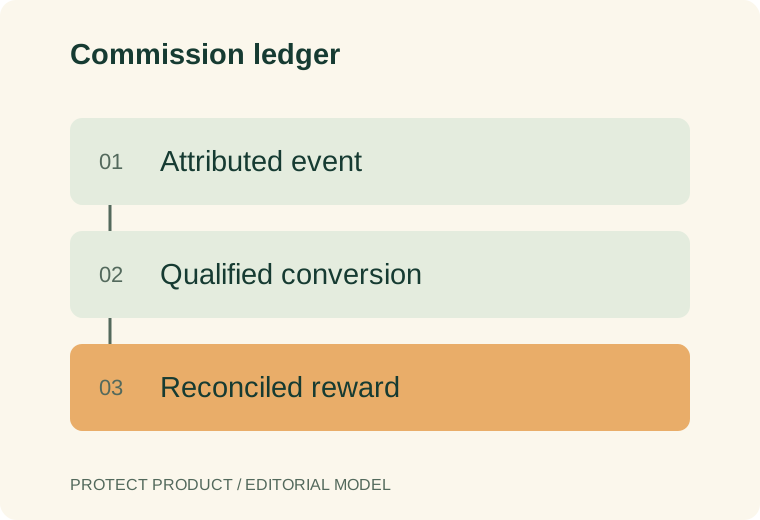
| Reward stage | Record | Question to answer |
|---|---|---|
| Referral | Publisher and attribution event | Which source may receive credit? |
| Signup | Server account event | Did a real product event occur? |
| Qualification | Purchase or other stated condition | Was the program requirement met? |
| Holding period | Refund and case status | Is commission still pending? |
| Approval | Reviewer or rule version | Why is payment authorized? |
| Reversal | Original reward and reason | What changed after approval? |
Evaluate affiliate compliance and creator authenticity separately
Influencer fraud tools inspect a different population
HypeAuditor publishes creator authenticity, audience and engagement analysis. Modash describes creator discovery, audience analytics and campaign operations. These are relevant candidates when a brand wants to vet a creator's audience before committing a campaign budget. A tool that scores visitors arriving at a website cannot, by that fact alone, establish whether an influencer's followers are authentic.
Use a hypothetical campaign with one creator, a tracked landing page and a separate sales ledger. Review audience evidence before launch, attribution and traffic quality during the campaign, and the resulting eligible conversions after the agreed window. Keep those stages separate so a low-quality audience estimate does not become a fabricated count of fraudulent purchases. Request the creator platforms' actual coverage for the networks and markets you use.
Japan monitoring should follow the disclosure question
Japan's Consumer Affairs Agency guidance explains the stealth-marketing designation effective October 1, 2023. It addresses advertising that consumers cannot readily recognize as advertising, including certain third-party promotional arrangements. This is a different issue from detecting automated clicks or a referrer opening duplicate accounts.
An affiliate-compliance evaluation should ask which channels, language variants and geographic views the monitoring tool can inspect, which evidence it retains and how a reviewer tracks a correction. AdPolice presents brand and affiliate-compliance monitoring and a guided brand-check entry point. Verify the coverage for your actual Japanese campaigns in the proposed service. A software feature or a completed brand check does not itself certify a campaign's legal compliance. Use the official guidance for the applicable disclosure requirements.
Make the review record auditable
For a disputed affiliate conversion, retain the publisher reference, campaign terms, landing-page event, relevant device/account context and the payout or reversal decision. For a disclosure issue, retain the actual placement and its review context instead. These records answer different questions and should remain distinguishable even if they appear in one investigation interface.
A practical correction process assigns an owner, records the decision and checks that the intended change occurred. That gives a buyer a concrete acceptance test for monitoring and case handling. It avoids treating every alert as lost revenue or every rejected conversion as confirmed fraud.
Compare affiliate and display validation with the correct denominator
For programmatic display verification, HUMAN and Fraudlogix are relevant specialist candidates. Inspect the actual impression-level invalid-traffic classification and the service's supported inventory and reporting. For an affiliate campaign, the business also needs the publisher reference, conversion qualification, attribution window and later payout or reversal. A first-party account-risk product such as ShieldLabs contributes device/account evidence at that conversion rather than replacing impression verification.
Ask each supplier to explain a permitted impression, an invalid-traffic finding, an eligible affiliate conversion and a reversed conversion separately. Compare classification errors only against equivalent confirmed labels. Traffic-validation accuracy, qualified-conversion yield and recoverable spend have different denominators; one percentage should not stand in for all three. Retain the verification output alongside the campaign and settled outcome so an operator can inspect why a case changed.
Sources
- HypeAuditor · read
- Modash · read
- Japan Consumer Affairs Agency: stealth marketing · read
- AdPolice · read
- HUMAN advertising and application products · read
- Fraudlogix verification and IP-risk products · read
- ShieldLabs device and account-risk context · read
Continue reading
FAQ
Which tools should I inspect for influencer-audience authenticity?
HypeAuditor and Modash provide relevant creator and audience analytics. Compare supported social networks, audience evidence and campaign workflow. Website-visitor risk and affiliate payout checks address additional parts of the campaign.
Can an affiliate monitoring tool certify Japanese advertising compliance?
A tool can help collect and review campaign evidence, but software monitoring does not itself certify compliance. Check the applicable official Consumer Affairs Agency guidance and verify the actual channel, language and geographic coverage of the proposed service.
Summarize with AI
Validate events at the application boundary
Use trusted server records for the qualifying event. A browser callback can describe an action but should not independently authorize commission. Authenticate incoming partner events according to the integration contract and reconcile them with your own account or order references.
OWASP’s REST Security Cheat Sheet provides security guidance for API access and data handling. Apply it to the conversion interface as well as the main product API.
Deduplicate deliveries using the relevant business event. Replaying a legitimate callback after a timeout should not create a second payable commission. Retain pending and unknown states until reconciliation finishes.
Review relationship evidence in context
Self-referrals and related-account activity need the program’s actual eligibility policy. Account, payment and device relationships can support a review, but shared infrastructure is not a complete finding.
A hypothetical agency refers two unrelated clients who completed setup using its office network. A shared IP is expected in that workflow. A different case might show repeated referrals to accounts controlled by the same beneficiary. The evidence and contractual rule should explain the distinction.
The referral fraud article covers reward loops inside a product. Multi-accounting detection explains the limits of account links.
Investigate attribution disputes separately
Two publishers may claim one legitimate customer because of overlapping touchpoints, tracking gaps or different attribution rules. That does not make the customer fake. Keep attribution resolution separate from a fraud finding.
Record which program rule determined credit and allow the operating team to explain it. Avoid using a device match to quietly override a contractual attribution model. If the model changes, retain the effective date and handle older events under the appropriate rule.
For paid-media quality concerns, use the click farm and ad fraud guide. Media invalidity and affiliate eligibility overlap in some cases but are not identical metrics.
Reconcile before payout
Join approved rewards to final orders, subscription states and recorded reversals. Track how the program handles partial refunds, cancellations and unresolved reviews. Give finance an export that can be traced back to the original qualifying event.
Require an owner for manual commission adjustments. Keep the reason and original value rather than overwriting the past silently. A clear ledger helps distinguish a tracking bug from suspected publisher misconduct.
Measure the program without assuming every rejection is fraud
Track qualified customers, sustained revenue, confirmed abuse, reversed commissions and publisher appeals. Compare sources using matching observation windows. Do not report all unapproved signups as fraud prevented.
Start an evaluation with one reward rule and a reviewed sample. A useful detection tool should help staff explain why a conversion qualified, failed or remained unresolved. That operating result matters more than an impressive total of flagged clicks.
FAQ
Is low conversion from an affiliate fraud?
Not necessarily. Targeting, product fit, technical issues and invalid activity can produce different explanations. Investigate before assigning intent.
Can client-side tracking approve commission?
It should not be the only authority. Reconcile the qualifying action with trusted server records and the program’s rules.
Does a shared IP prove self-referral?
No. Agencies, workplaces and households may share networks. Review stronger relationship and eligibility evidence.
Sources
Editorial basis: primary-source documentation and a practical evaluation framework. Examples are hypothetical unless explicitly identified otherwise. This article does not report an independent vendor benchmark.
For evaluation standards and corrections, see our methodology and contact page.