Read this article with AI
Copy the article text into your chosen tool to inspect its sources and trade-offs.
Define the entity being recognized
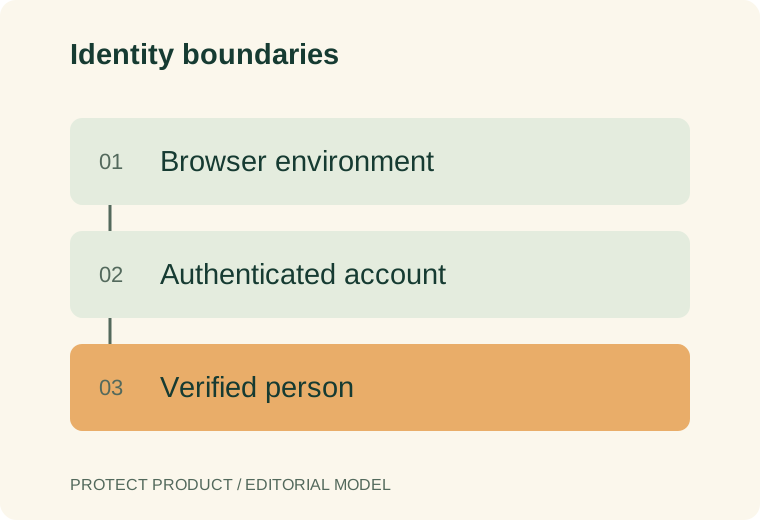
A visit, browser environment, physical device, authenticated account and person are different entities. A service can return an identifier without establishing all of them. Ask the provider to define each field and relationship.
For example, a hypothetical customer uses a phone and laptop under one authenticated account. The account can connect those sessions because the app has established the account relationship. That does not mean that an anonymous device observation alone revealed the same person on both devices.
The browser-techniques guide explains environment observations. Keep the account join explicit when building a recognition workflow.
Understand what cookie independence changes
Stored browser state can help recognize a returning client, but it may be absent or changed. Other observations can provide context when the expected state is missing. The useful question is how the chosen implementation handles that situation on supported clients.
W3C’s fingerprinting guidance explains why exposed browser information and privacy mitigations matter. “Cookieless” should not be read as unlimited access to a permanent cross-site identity.
| Claim | Question to verify |
|---|---|
| Recognizes returning visitors | Which entity, client set and observation window? |
| Works after cookie clearing | Which signals remain and how is uncertainty shown? |
| Supports incognito or private modes | What was actually tested on each supported browser? |
| Links devices | What authorized evidence creates the account relationship? |
| Helps prevent fraud | Which protected action and policy use the result? |
Keep anonymous-to-known joins deliberate
When a visitor authenticates or provides information through an appropriate flow, the app may have a basis to associate earlier activity with an account. Record the event and purpose of that association. A guessed personal identity is not a substitute for an established account join.
Do not expose private account details because an environment looks familiar. Normal authentication and authorization remain necessary. The account-risk signals guide explains the distinction between contextual familiarity and session authority.
For personalization, consider whether contextual content is enough. A visitor can receive useful navigation based on the current journey without a claim that the business knows who they are. The anonymous personalization article covers that narrower design choice.
Test returning behavior and mistaken links
Prepare a controlled matrix: a known returning browser, an ordinary software change, a different physical device and a legitimate shared device. Define expected results and record the conditions before running the test.
Separate missed returning recognition from mistaken links and unavailable results. Those states have different costs. A missed match can fragment analytics, while an incorrect link can affect another customer’s access or offer eligibility.
Use the provider evaluation guide to ask about correction, event integrity and platform coverage. Avoid turning a small controlled example into a universal persistence or accuracy claim.
Align analytics definitions with the identity model
A change in recognition can change reported new and returning counts even if customer behavior stays the same. Keep the identifier definition and collection coverage with each report. A customer using several devices may appear in more than one environment-level record.
The new-versus-returning guide explains how to compare cohorts and avoid a universal benchmark ratio. Search Console impressions are a separate visibility metric and should not be treated as visitor identity observations.
When comparing tools, preserve the same time window and population. A more permissive relationship policy can increase apparent recognition while also increasing mistaken joins. Review both outcomes.
Review data handling as part of the purchase
Document collected fields, intended use, retention and who can access the relationship data. Keep this aligned with the business’s reviewed privacy practices and customer communications. A product label alone does not answer those questions.
Choose the first business use narrowly. A returning-environment signal for fraud review can require a different policy from marketing personalization. Maintain the purpose and account boundary instead of allowing every downstream system to treat the identifier as a verified person.
FAQ
Does cookieless mean completely anonymous?
No. It describes a technical dependency, not a complete statement about whether data is identifiable or how it is used.
Can a returning visitor be recognized across every device?
Do not assume that. Ask what evidence creates the cross-device relationship and what uncertainty remains.
Can a familiar device bypass authentication?
An environment observation is a risk input. Private account access still needs the application’s valid authentication and authorization flow.
Sources
Editorial basis: primary-source documentation and a practical evaluation framework. Examples are hypothetical unless explicitly identified otherwise. This article does not report an independent vendor benchmark.
For evaluation standards and corrections, see our methodology and contact page.