Read this article with AI
Copy the article text into your chosen tool to inspect its sources and trade-offs.
Choose the customer task before the identifier
A visitor reading integration documentation may need technical navigation. Someone comparing plans may need the next relevant pricing explanation. These experiences can improve a journey without guessing a name, employer or private customer history.
Write a narrow hypothesis: which context will change which interface element, and what customer outcome should improve? Avoid collecting a broad identity profile simply because a tool makes it possible.
The cookieless identification article explains the recognition boundary. An environment estimate can be useful without being treated as a verified personal identity.
Separate contextual and account-based experiences
| Experience | Possible basis | Boundary to preserve |
|---|---|---|
| Relevant navigation | Current page or selected topic | Do not infer private account membership |
| Returning-journey reminder | Appropriate first-party state | Explain the state and handle missing data |
| Account dashboard | Valid authenticated account | Require ordinary authorization |
| Offer eligibility | Defined campaign and claim history | Enforce the benefit rule on the server |
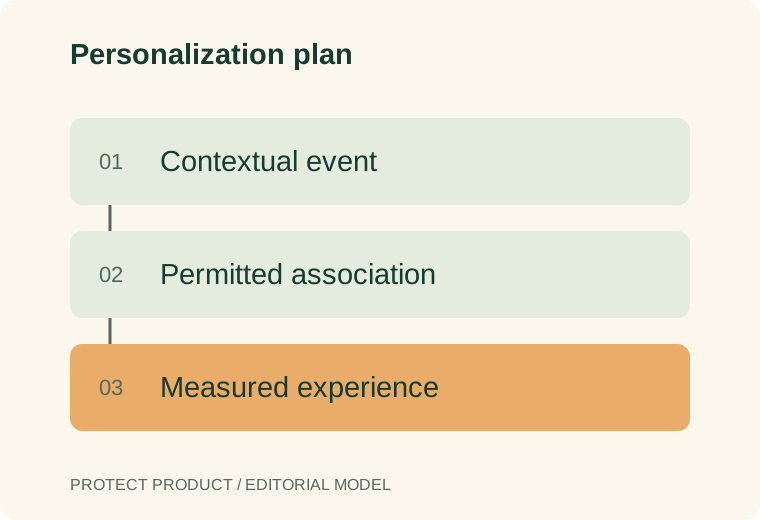
If a visitor later authenticates, make any association with earlier activity deliberate and reviewable. Record the event and purpose. An anonymous-to-known join should not be inferred merely because two sessions resemble one another.
Avoid personalization that grants authority
Showing a relevant article and exposing a customer’s billing page are different actions. A recognizable environment does not establish that the person operating it may access private data.
OWASP’s authorization guidance is the appropriate foundation for protected resources. Personalization should fit within the application’s permission model rather than creating a side route around it.
For a hypothetical product website, a returning documentation visitor could receive a shortcut to the last public topic. The same signal should not display a remembered customer’s invoices. That distinction keeps the useful context without inventing account authority.
Keep collection aligned with the stated purpose
Inventory what data the experience actually needs, where it is stored and who can use it. Keep retention and customer communications consistent with the business’s reviewed data practices. “Anonymous” is not a complete description of every technical identifier or later join.
W3C’s fingerprinting guidance provides technical context for how browser information can contribute to recognition. A marketing label should not conceal the actual collection method.
Include a neutral default when context is absent or uncertain. Customers should still be able to find the product information they need. Avoid a design where an incorrect inferred segment makes a relevant plan or support route disappear.
Test the product hypothesis with a clear outcome
Choose a task-completion metric before launching the experience. Possible outcomes include finding the correct documentation, completing a relevant product action or understanding an offer. A rising click count on a personalized card does not alone establish that the visitor was better served.
Keep the experiment’s assignment, exposure and outcome definitions. If an identity or collection change occurs during the test, record it. Otherwise, a changed visitor classification can be mistaken for a personalization effect.
The new-versus-returning guide explains why those categories need a stable denominator and time window. Use it before treating a visitor mix as evidence that an experience worked.
Separate risk assessment from marketing decisions
A fraud signal can inform a protected business action, but it should not automatically become a marketing persona. Document why data flows between systems and which decisions each system owns.
For an introductory offer, personalization may explain the offer, while the backend ledger decides eligibility. The trial-prevention guide covers that grant boundary. Do not let a different interface variant unintentionally issue a second benefit.
Review customer feedback alongside the experiment. Incorrect context, surprising reminders and missing defaults can reveal problems that a conversion chart misses. Keep a way to correct the experience without rewriting account history.
FAQ
Can a website personalize before a visitor logs in?
It can use suitable current-page and first-party context. That does not establish the visitor’s personal identity or permission to view private account data.
Does cookieless recognition make a visitor fully known?
No. Environment recognition and an authenticated account association are different claims.
Which metric should judge the experience?
Use the customer task the experience is meant to improve, with a stable exposure and outcome definition. Do not rely solely on card clicks or a new/returning ratio.
Sources
Editorial basis: primary-source documentation and a practical evaluation framework. Examples are hypothetical unless explicitly identified otherwise. This article does not report an independent vendor benchmark.
For evaluation standards and corrections, see our methodology and contact page.