Read this article with AI
Copy the article text into your chosen tool to inspect its sources and trade-offs.
Define which event is being measured
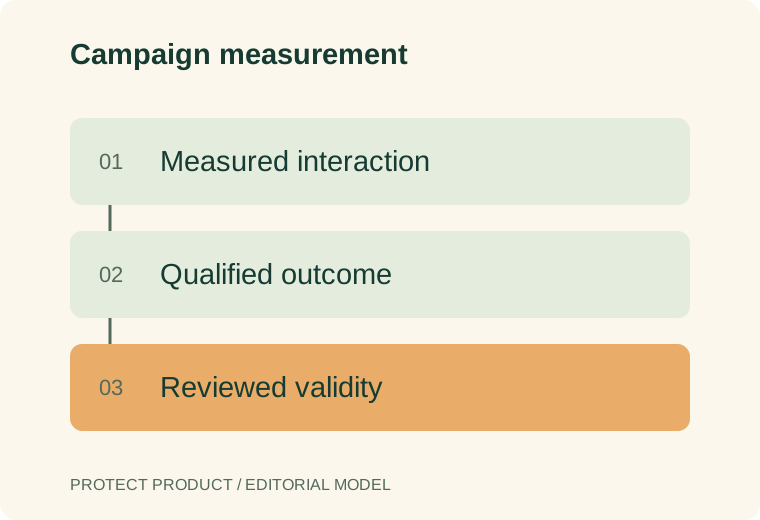
Separate served impressions, clicks, landing sessions, registrations and paid conversions. An ad platform and your application may count different events with different filters. A discrepancy is a question to investigate, not immediate proof that one party is fabricating traffic.
For each metric, record its definition, time zone, attribution window and filtered population. Keep gross and filtered totals distinguishable. Otherwise a chart can appear to show improvement simply because the counting rule changed.
The Media Rating Council’s June 2020 IVT addendum distinguishes general and sophisticated invalid traffic in media measurement. Use that dated document for terminology; check current MRC standards and a supplier’s exact accreditation scope when procuring measurement services.
Keep SIVT separate from a vendor score
SIVT means sophisticated invalid traffic within the relevant measurement framework. It is not a synonym for every suspicious account, every low-quality lead or every low bot score. A fraud API may contribute evidence without providing an accredited advertising measurement service.
| Observation | Next question | Incomplete conclusion |
|---|---|---|
| Many clicks, few useful actions | Is targeting, landing UX or traffic validity responsible? | Every non-converting click is fraud |
| Repeated environments | Is there coordinated activity or legitimate sharing? | One fingerprint equals one operator |
| Invalid traffic report | Which standard, population and filters were used? | Every provider uses the same denominator |
| Conversion reversal | Did the underlying purchase fail or violate terms? | All attributed traffic was fake |
Connect campaign records to qualified outcomes
Keep campaign and placement references through the permitted analytics path. Join them to server-confirmed business events using a documented attribution model. A client-side conversion callback should not independently create a payable lead or reward.
In a hypothetical campaign, one publisher produces many registrations but almost no completed onboarding. That pattern could reflect poor targeting, a technical failure or coordinated low-value activity. Inspect the landing flow and case evidence before assigning fraud intent or withholding payment.
The affiliate fraud guide covers reward qualification. The fake account guide covers account eligibility after the click.
Distinguish supply-chain transparency from visit validity
IAB Tech Lab’s ads.txt project lets publishers declare authorized sellers. Sellers.json and the SupplyChain object help buyers understand entities in the selling path. Those mechanisms address supply transparency; they do not individually prove that each click or conversion is genuine.
Review both the inventory purchase path and the downstream activity. Keep evidence from a supply check separate from a finding about an individual visitor. This makes supplier disputes clearer and avoids overstating what one technical file established.
Test traffic-quality products against the right evidence
Ask what the service observes, which media and platforms it covers, how it reports unknowns and whether a case can be investigated. If accreditation is claimed, verify the named product and scope rather than relying on a logo on a landing page.
Include legitimate low-engagement visits and known technical failures in a pilot. Compare decisions against confirmed outcomes where available, leaving unresolved cases unresolved. Device and network evidence can support the analysis; see residential proxy detection for shared-network pitfalls.
Make campaign changes with a documented reason
Record the affected source, evidence, measurement window and change made. Track legitimate conversions and customer quality after a placement is paused or a filter changes. A lower click count is not the same as lower wasted spend.
Finish the investigation with the narrowest supported finding: a counting discrepancy, unsuitable traffic, a technical defect or confirmed invalid activity. That is more useful for the next media purchase than a broad “bots removed” total with no denominator.
FAQ
Are click farms always bots?
No. Coordinated activity may involve people, automation or both. Evaluate the validity and purpose of the measured activity.
Does ads.txt stop click fraud?
It supports authorized inventory sales. It does not prove that every resulting interaction is valid.
Can a bot score be reported as SIVT measurement?
Only if the actual measurement method and service scope support that claim. The labels are not interchangeable by default.
Sources
Editorial basis: primary-source documentation and a practical evaluation framework. Examples are hypothetical unless explicitly identified otherwise. This article does not report an independent vendor benchmark.
For evaluation standards and corrections, see our methodology and contact page.