Read this article with AI
Copy the article text into your chosen tool to inspect its sources and trade-offs.
Define the access contract
List public previews, metered pages, subscriber-only articles and licensed access. Specify what each account or subscription permits, including team seats and institutional arrangements. A user with a valid login may still lack access to a particular publication or archive.
OWASP’s Authorization Cheat Sheet distinguishes permission from authentication and recommends checking access on requests. Apply that distinction to both the page and any API or asset that supplies protected material.
This guide addresses publisher controls. Consumer searches about bypassing a newspaper paywall have a different intent; they are not instructions for circumventing a publisher’s access rules.
Enforce entitlement at delivery
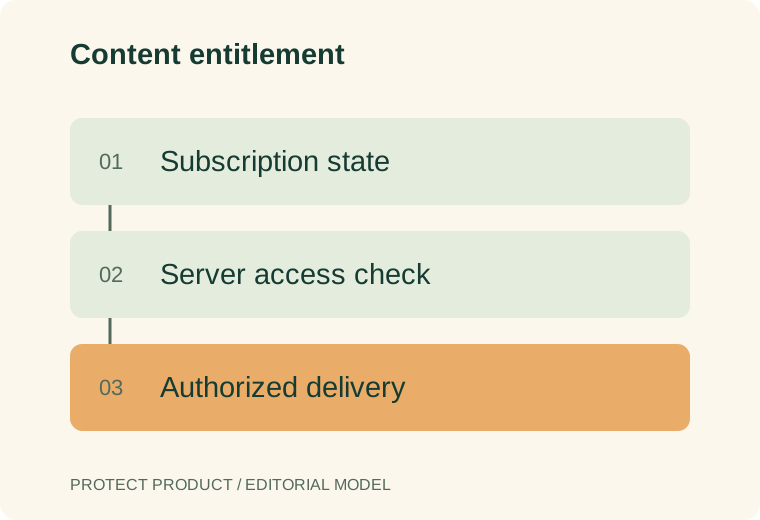
Decide which component checks the current subscription state before returning protected content. The visible page, article API, download route and app may all need the same entitlement policy. Hiding text with a visual layer does not change what has already been delivered.
| Surface | Check to make | Common ownership gap |
|---|---|---|
| Article page | Which content may this visitor receive? | Browser layer treated as access enforcement |
| Content API | Is this account entitled to this resource? | API assumes page checks already ran |
| Download | Is the file covered by this subscription? | Permanent public asset URL |
| Mobile app | Does the server apply the same access rules? | Client-only subscription flag |
| Cache | Can one user’s response reach another user? | Cache policy detached from entitlement |
Review caching with the delivery path
MDN’s Cache-Control reference explains how browser and shared-cache directives differ. Review the actual origin, CDN and application configuration together. No single header example should be copied as a complete paywall architecture.
In a hypothetical publisher, an authenticated subscriber requests an article that passes through a shared cache. The team must verify that a later anonymous request receives only its authorized response. Test the real cache behavior rather than checking that one header exists.
Include cancellation, expiry and plan-change cases. Access records and cached content can otherwise disagree about a subscriber’s current rights.
Keep search visibility intentional
Publishers may choose to let search engines index paywalled material under a supported model. Google’s paywalled-content documentation describes markup for that purpose. Structured data describes the page; it does not enforce subscriber access.
Follow the crawler’s current verification guidance when access policy depends on verified crawler status. A user-agent string alone is not a reliable identity. The AI bot detection guide explains how to keep verified automation separate from abusive actions.
Document which crawler access is intended and what ordinary visitors receive. Search and security owners should review the same delivery design rather than apply conflicting rules independently.
Address account sharing through the subscription policy
Concurrent sessions can reflect a customer’s phone and laptop or an allowed team subscription. Apply the actual seat and sharing rules. Device associations can help review repeated access without establishing how many people are present with certainty.
Use account sharing detection for seat and concurrency design. Use account takeover signals when evidence suggests unauthorized access rather than consensual sharing.
Provide a reasonable session-management and support flow. Mistaken restrictions should not require a customer to abandon a valid subscription.
Test access outcomes, not just block counts
Use authorized test accounts for anonymous, expired, active, upgraded and team-seat states. Check pages, APIs, downloads and app delivery. Include cache transitions and interrupted subscription updates.
Measure unauthorized deliveries, legitimate subscriber failures, support cases and confirmed automated extraction separately. A request block can protect capacity without proving a subscription violation. Start with the delivery boundary, then add account and traffic controls for the gaps the tests reveal.
FAQ
Does a JavaScript overlay secure paid articles?
It does not by itself enforce what the server delivers. Choose an access design that matches the publisher’s content and indexing policy.
Does paywall schema control access?
No. It describes paywalled content for supported search use. The application must still enforce entitlement.
Should every second device be blocked?
No. Apply the subscription’s seat and sharing rules, with a path for ordinary device changes and legitimate multi-device use.
Sources
Editorial basis: primary-source documentation and a practical evaluation framework. Examples are hypothetical unless explicitly identified otherwise. This article does not report an independent vendor benchmark.
For evaluation standards and corrections, see our methodology and contact page.