Read this article with AI
Copy the article text into your chosen tool to inspect its sources and trade-offs.
Separate the client from the action
An automated assistant can retrieve a public page, act on a user’s request or attempt a protected purchase. Those actions create different obligations for the website. Recognizing an automation provider does not authorize it to use a customer account or consume a paid entitlement.
Create an inventory with the route, request type, account context and permitted operation. A documentation crawler might need public text, while a purchasing agent needs the application’s normal authentication and checkout controls. Keep that distinction visible in policy and logs.
The bot detection buyer guide explains the main control families. Use this article for the narrower question of automation identity and permission.
Verify a claimed crawler identity
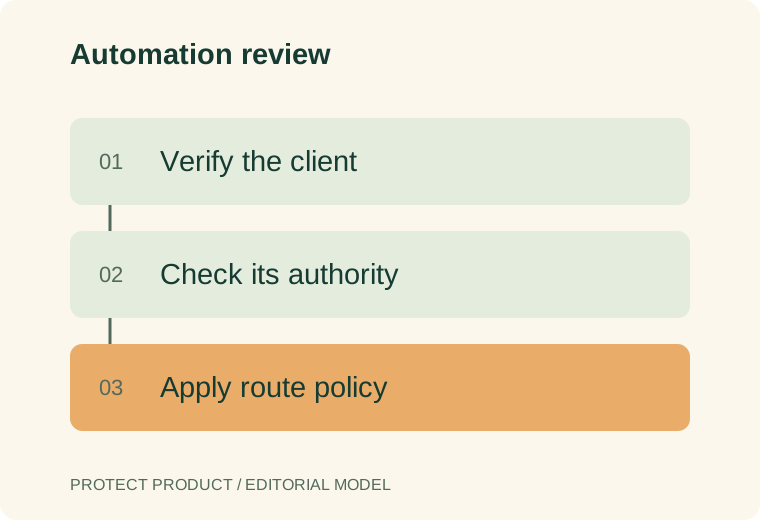
Google’s crawler verification documentation describes verification using published network information or a reverse-DNS and forward-DNS procedure. A request claiming to be Googlebot is not established as such merely because its header contains that name.
For another provider, follow that provider’s current verification method. Check whether it publishes ranges, signed-request mechanisms or another documented contract. Maintain the verification step as a supported integration rather than copying an unexplained allowlist from an old blog post.
| Request situation | Evidence to inspect | Separate permission question |
|---|---|---|
| Public indexing crawler | Provider verification and requested route | Is this content available for crawling? |
| User-triggered retrieval | Documented client identity and route | Is the resource public or authenticated? |
| Customer agent using an account | Account authorization and session evidence | May this account perform the action? |
| Unverified automated client | Request context, rate and behavior | Which public access limits apply? |
Keep robots policy and access control distinct
A robots file communicates crawling instructions. It should not be the only barrier protecting private content or an expensive operation. If a resource requires an entitlement, enforce that requirement in the delivery or application path.
Similarly, a browser challenge does not establish that an automated client has a customer’s permission. A purchasing workflow still needs account authorization, stock rules and a safe payment path. The paywall control guide covers the same boundary for protected content.
Consider a hypothetical documentation site with public API references and an authenticated billing page. The public references may be useful to assistants that answer customer questions. The billing page should remain behind normal account authorization regardless of whether the requesting client is a known crawler.
Evaluate bot products without an unsupported AI label
Ask which evidence a vendor returns and how it is defined. A label such as “AI bot” can describe a verified provider, a traffic category or a heuristic classification. Those interpretations have different consequences for an allow policy.
Inspect missing and uncertain results. An unrecognized client may be new, privately deployed or simply outside the provider’s classification. That is different from proof of malicious intent. Record the reason for a restriction in terms your support and operations teams can investigate.
Cloudflare’s bot documentation provides one example of a request-oriented score. Do not convert a vendor’s automation score into a universal measure of account trust or agent authorization.
Monitor permitted automation as an integration
Measure successful retrieval, error responses, load and customer outcomes for each permitted client category. Keep sensitive account actions in their own reports. A rise in public retrieval traffic does not automatically mean a rise in attempted account abuse.
Set an owner for verification updates. If a provider changes its network ranges or request method, operations should know whether access is being rejected or unintentionally broadened. Include a narrow rollback for the affected policy.
When an automated client reaches signup or checkout, continue the normal business controls. The API integration guide explains event binding and safe retries; the account-risk guide covers sensitive session actions.
FAQ
Can an AI bot detector tell whether an article was AI-written?
That is a different task. This guide concerns clients making requests to a website, not authorship classification of text.
Should verified crawlers bypass all security rules?
Grant only the access appropriate to the verified client and route. Authentication, resource entitlement and business-action rules remain separate decisions.
Does robots.txt stop unauthorized access?
It is a crawling-policy mechanism. Private resources and protected operations need their own enforceable authorization controls.
Sources
Editorial basis: primary-source documentation and a practical evaluation framework. Examples are hypothetical unless explicitly identified otherwise. This article does not report an independent vendor benchmark.
For evaluation standards and corrections, see our methodology and contact page.