Read this article with AI
Copy the article text into your chosen tool to inspect its sources and trade-offs.
Write the contract before adding the snippet
Name the business action, authenticated account if one exists, client observation reference and server decision reference. Decide who creates each value and which service verifies it. A client can submit an identifier, but your server must establish what that identifier refers to before relying on it.
The contract should answer a practical question: can a result from one action be presented as evidence for another? Use the vendor’s documented association and freshness controls. Different products retrieve collected events, evaluate server requests or combine both approaches. Do not assume that one vendor’s request format applies to another.
Keep the general fraud API guide nearby if the integration also evaluates account or payment context. A request-automation verdict and a business-risk result can have different meanings.
Validate challenge results at the server
Cloudflare’s Turnstile documentation requires server-side Siteverify validation. It also documents a five-minute validity period and single-use tokens. Those rules are product-specific, but the broader implementation lesson is useful: the client’s apparent success is only one stage of the control.
Check the expected hostname, action and other relevant fields where the chosen service exposes them. Keep its secret credential in the server environment. A designated public client key belongs to a different trust boundary.
| Integration state | Meaning | Application response to define |
|---|---|---|
| Evaluated | Expected evidence was validated | Apply the versioned action policy |
| Missing | No usable observation arrived | Retry, verify another way or review |
| Expired | Evidence is outside the accepted window | Obtain a new assessment |
| Duplicate | The action or evidence was already consumed | Return or reconcile the earlier result |
| Unavailable | The service did not return a timely result | Use the documented fallback |
Keep the business operation safe to retry
A customer may submit a form twice or repeat a request after a timeout. A network failure does not prove that the earlier operation never ran. Store a business-action identifier and ensure that repeating it cannot issue another benefit or create a second charge.
Treat evidence validation and the protected operation as related but distinct steps. If a token is single-use, retrying validation may have a different outcome from retrying a completed signup. Preserve the reference needed to explain that distinction.
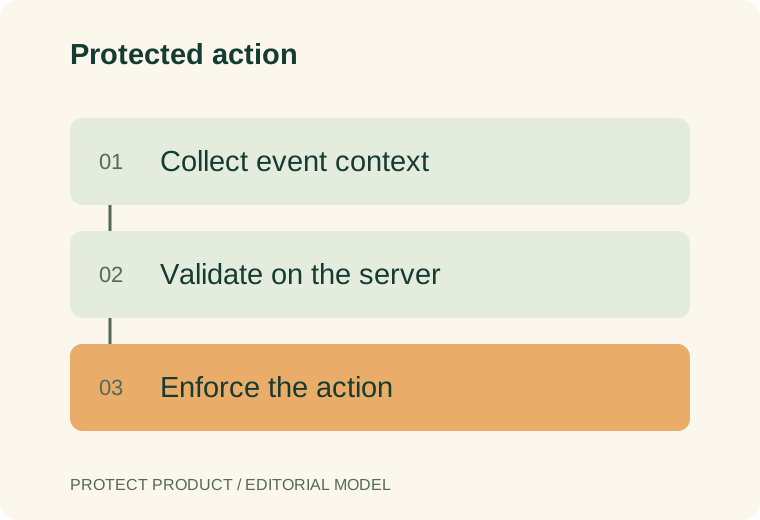
For a hypothetical signup flow, the server first establishes the request’s account or anonymous session context. It validates the expected assessment, checks the offer ledger and records one eligibility decision. The response then tells the browser what happened. Changing a hidden field should not grant a second trial.
Apply controls to the routes that matter
Adding a script to the homepage does not demonstrate protection of a JSON API, mobile endpoint or alternate form route. Inventory the actual entry points. Include account recovery, embedded checkout, partner integrations and any endpoint that grants a costly resource.
For a WordPress site, identify which plugin or server component validates the protected form. Confirm what happens if another plugin replaces that form or changes its route. A visible widget on a page is insufficient evidence that every submission path uses the check.
The REST security guidance from OWASP is useful for the surrounding API boundary. Keep application authorization and input handling in scope when integrating a third-party assessment.
Test failures without creating a customer incident
Use an appropriate test environment to inspect an absent observation, expired reference, delayed response and duplicate submission. Record what the customer sees and what support can investigate. A predictable retry screen is different from an unhandled exception or silent unrestricted access.
Then test ordinary returning customers and permitted automation. A technically valid assessment can still feed a policy that creates unnecessary friction. The CAPTCHA alternatives guide explains why a challenge result and customer authentication answer different questions.
Define ownership and a rollback boundary
Assign someone to monitor usage, credentials, product changes and unavailable results. Document who can disable an enforcement rule and which routes the fallback affects. Avoid a global switch that unexpectedly removes protections from unrelated actions.
Before release, reconcile vendor requests with protected business operations. Investigate loops and duplicate collection before interpreting a usage spike as hostile activity. Use the pricing worksheet to keep that request accounting tied to the purchased unit.
FAQ
Can I trust a score submitted by JavaScript?
Treat client data as input to verify. Follow the selected service’s server integration contract before using an assessment to authorize an operation.
Should every API timeout block the customer?
Choose a response for the action’s risk and available recovery options. Preserve an unavailable state rather than labeling the customer as evaluated low risk or confirmed abusive.
Does adding a widget protect a mobile API?
It does not establish that coverage. Check the mobile integration and the server route that performs the protected action.
Sources
Editorial basis: primary-source documentation and a practical evaluation framework. Examples are hypothetical unless explicitly identified otherwise. This article does not report an independent vendor benchmark.
For evaluation standards and corrections, see our methodology and contact page.