Read this article with AI
Copy the article text into your chosen tool to inspect its sources and trade-offs.
Map how value enters and leaves
List every operation that changes a card’s value or exposes its credentials. Include customer service tools and scheduled jobs as well as the storefront. Name the system of record and the team allowed to approve exceptions.
Separate the purchase payment from the stored-value balance. A paid order, an issued gift card and a redeemable balance can reach their final states at different times. A later payment dispute should trigger a defined investigation, not an unexplained edit to historical ledger entries.
| Operation | Control to evaluate | Record to retain |
|---|---|---|
| Funding | Payment and order validity | Provider event and order reference |
| Issuance | Authorized creation of value | Issuance ID, amount and reason |
| Balance access | Permission and request controls | Outcome without exposed credentials |
| Transfer | Current owner’s authority | Sender, recipient and approval event |
| Redemption | Available balance and eligible purchase | Atomic ledger change and receipt |
| Adjustment | Staff permission and reconciliation | Reviewer, reason and original event |
Protect balance and redemption endpoints
Enforce access checks on the server for each relevant operation. OWASP’s Authorization Cheat Sheet recommends validating permissions on every request. A gift-card interface needs the same discipline as other value-bearing application functions.
Limit repeated requests according to the service’s actual access model. Do not return unnecessary details that expose card credentials or customer data. Keep public failure messages appropriate for customers while retaining enough private evidence for an incident review.
The bot API integration guide explains how to attach traffic evidence to a server-side action. The action’s permission check still needs to run even when a bot signal looks benign.
Make value changes atomic and repeatable safely
A redemption should not spend the same balance twice when two requests arrive together. Design the ledger update around the consistency guarantees of the chosen database and payment integration. Define which failures can be retried and which require reconciliation.
In a hypothetical store, checkout times out after reserving part of a gift-card balance. A retry should find the existing operation and its state. Creating a second unrelated debit or credit would turn a connection failure into a financial error.
Stripe’s idempotent-request documentation illustrates provider-specific retry behavior. Your internal ledger also needs its own operation identity; a gateway key does not automatically protect every internal step.
Review account changes before high-value actions
A newly changed email, recent recovery and immediate transfer can merit additional verification. Review the sequence and the account’s authority to move value, with device or network evidence as context.
A new phone is not sufficient evidence of theft. Nor does a familiar environment prove that its current operator is the account owner. Provide a support route for the customer when a transfer or redemption is delayed.
Use account takeover signals to design checks around recovery and sensitive actions. Use the loyalty fraud guide when points and gift-card value interact, keeping their rules and balances separate.
Control support adjustments
Support staff may need to replace a card, correct an error or reverse a transaction. Give those operations explicit permissions and audit records. High-impact adjustments can require a second review under the business’s own policy.
Never use informal notes as the only record of newly created value. Link the adjustment to its original case and reconcile it with the ledger. Keep credentials and full redemption secrets out of ordinary support transcripts.
Measure financial integrity as well as blocked traffic
Track unexplained balance differences, duplicate operations, confirmed account theft, customer resolution time and legitimate redemption failures. A drop in requests does not prove the stored-value system is correct.
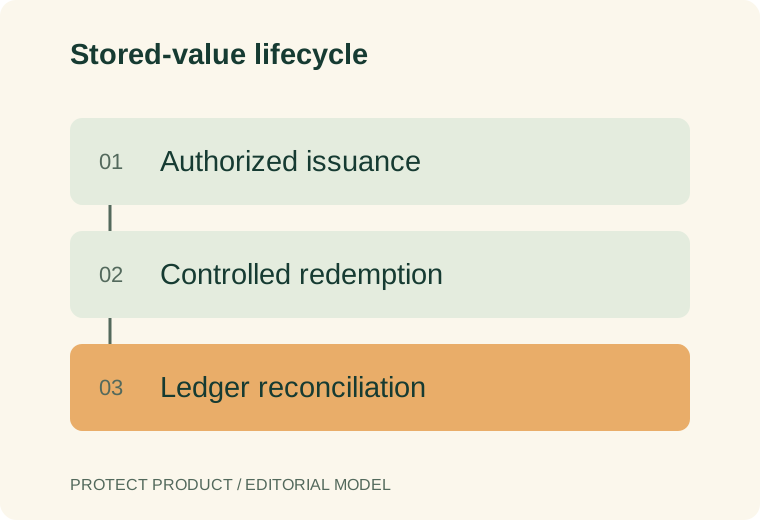
Test a complete authorized lifecycle in a non-production environment: fund, issue, partially redeem, retry, reverse and reconcile. Include a customer-support exception. Close the pilot only when both the fraud decision and ledger outcome can be explained.
FAQ
Is gift card fraud only a payment problem?
No. It can involve unauthorized issuance, account takeover, balance access, transfer or redemption as well as funding.
Can one risk score replace a gift-card ledger?
No. The ledger must enforce and reconcile value changes regardless of the risk service’s response.
Should support-created credits be audited?
Yes. Record the authorized operator, reason, case and resulting ledger change so exceptions remain accountable.
Sources
Editorial basis: primary-source documentation and a practical evaluation framework. Examples are hypothetical unless explicitly identified otherwise. This article does not report an independent vendor benchmark.
For evaluation standards and corrections, see our methodology and contact page.