Read this article with AI
Copy the article text into your chosen tool to inspect its sources and trade-offs.
Identify the source of each location
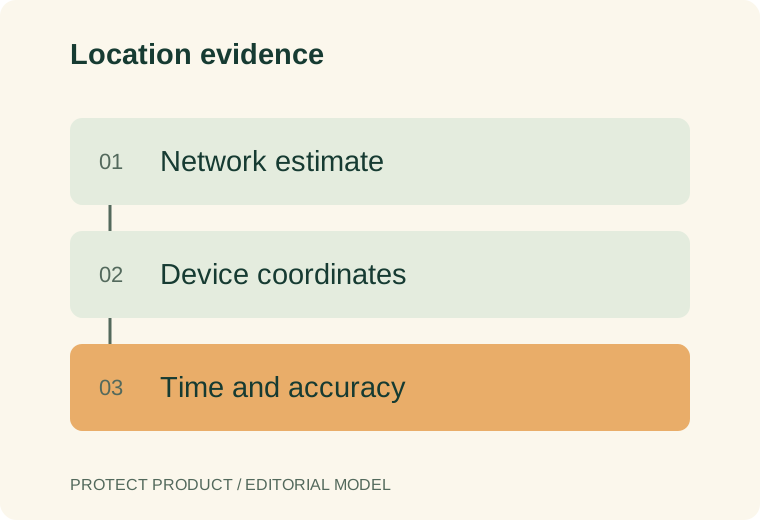
An IP-derived region and device-provided coordinates are different observations. They can differ for ordinary reasons, including network routing or privacy services. Record the source, collection time and relevant accuracy information before comparing them.
MDN’s geolocation reference defines a device-coordinate accuracy field in meters. A precise-looking latitude and longitude should not cause the app to ignore that uncertainty.
The proxy detection guide covers network masking. Use it to avoid treating an IP category as a direct measurement of the person’s physical location.
Build a location evidence record
| Observation | Context to keep | Question before action |
|---|---|---|
| Network-derived location | Address, source and observation time | What area does the estimate actually represent? |
| Device-provided coordinates | Collection method, time and accuracy | Is this result available and reliable enough for this action? |
| Account activity | Session and prior relevant event | Are the compared actions associated correctly? |
| Location inconsistency | Compared sources and uncertainty | What legitimate explanation remains? |
Keep denied permissions and unavailable observations explicit. A customer choosing not to provide optional location data has not supplied a false coordinate. The app needs a separate policy for missing data.
Check timing before calling travel impossible
Compare the event timestamps, their source and the actual account association. A delayed event, stale location or shared account can create an apparent travel pattern that needs investigation.
For a hypothetical marketplace, a phone event collected earlier may arrive after a later browser event. Sorting only by receipt time can imply a misleading sequence. Record both relevant event time and processing time where the system needs them.
The account-sharing guide explains why several locations can also involve permitted multi-device use or an entitlement issue. Do not force every inconsistency into an account-takeover label.
Preserve ordinary privacy and travel cases
Apple’s Private Relay documentation explains that its anonymous addresses map to a region without revealing an exact location or identity. This is one example of a legitimate network environment that can affect a website’s observations.
Include travelers, mobile connections, shared networks and privacy-service users in the pilot. Compare the result with the protected action and established account context. A long-standing customer viewing public content may need a different response from a session changing financial instructions.
The travel booking workflow applies that distinction to inventory holds, itinerary changes and refunds, where the customer’s current location and destination often differ legitimately.
The account takeover signals guide provides a way to assign those responses separately.
Choose the product surface and action
For native mobile applications, verify SDK coverage, permission behavior and the fields returned on the actual platform. A web browser and a native app do not necessarily expose the same location or integrity evidence.
Ask a vendor to explain which observation supports its location-related signal and what happens when that field is absent. A broad product claim should not hide unsupported clients or a requirement your app cannot meet.
Use the device intelligence guide to compare platform scope, and the mobile SDK checklist to inspect the integration. Do not infer geo-compliance from an ordinary risk API label.
Test the review and correction path
Prepare expected outcomes for a normal trip, an ordinary network change, stale data, denied optional permission and a controlled inconsistency. Ask to inspect the evidence and correct an inappropriate response.
Measure legitimate completion, investigated inconsistencies, unavailable results and time to recovery. An increasing number of location alerts is not proof that the business has reduced loss.
Choose a policy owner who understands the protected action. If a location decision affects eligibility, the app’s terms, permissions and reviewed requirements need to remain consistent with the implementation.
FAQ
Does an IP location prove where a person is standing?
No. It is a network-derived estimate with its own scope and uncertainty.
Does denied location permission prove spoofing?
No. It creates an unavailable observation. Define the supported fallback for that action.
How can a business avoid blocking legitimate travelers?
Inspect source, time, accuracy and account context, then apply a proportionate response to the specific action. Include normal travel in the pilot.
Sources
Editorial basis: primary-source documentation and a practical evaluation framework. Examples are hypothetical unless explicitly identified otherwise. This article does not report an independent vendor benchmark.
For evaluation standards and corrections, see our methodology and contact page.