Read this article with AI
Copy the article text into your chosen tool to inspect its sources and trade-offs.
Define the network question precisely
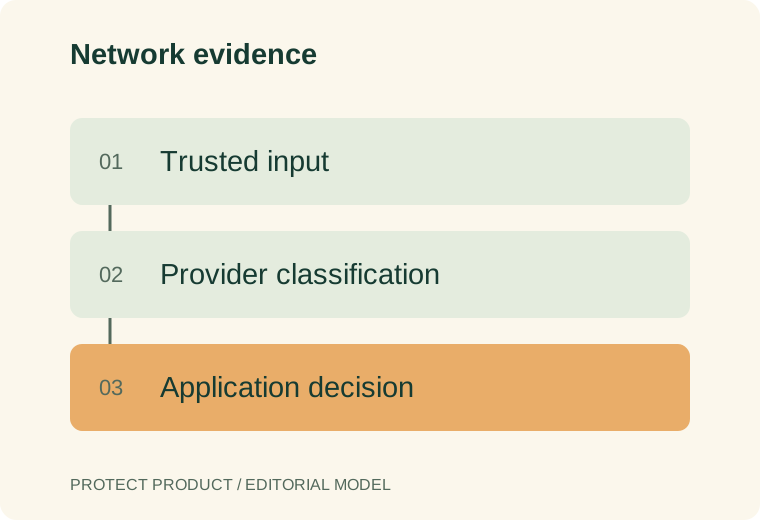
Residential proxies, hosting networks, mobile connections, Tor and privacy relays are not interchangeable categories. Ask how the vendor defines each label and what an unknown result means. A result can also depend on which client IP the integration actually submitted.
Review your trusted proxy configuration and the meaning of forwarded request headers. Resolve address attribution and IP-family handling before comparing detection results; a tool cannot correctly assess a customer connection if the application accidentally supplies its own reverse proxy’s address.
Compare the source and meaning of the output
| Evaluation question | Evidence to request |
|---|---|
| What is classified? | Documented category and field definition |
| What event is assessed? | IP or connection reference and observation time |
| How is uncertainty shown? | Unknown, missing and unavailable states |
| What can the reviewer inspect? | Supporting reasons and relevant account context |
| What platforms are supported? | Backend, web and mobile integration requirements |
| How is usage billed? | Lookup, identification or broader risk event |
Avoid assuming that every vendor uses the same data sources or freshness model. Ask what the purchased service establishes and what evidence can be checked during a pilot. “Real time” should describe a defined part of the response, not serve as a substitute for a documented result.
A public test page has an even narrower scope. Our anonymity check guide explains which browser observations a test can expose and where its conclusions stop. Use the checker and demo directory to inspect the distinction between browser tests and address lookups before treating one visit as a guarantee about privacy or another service’s verdict.
Build a shortlist around the business action
A narrow lookup can fit a team that already operates its account and decision system. A broader platform can connect network context with device or account evidence. Those are different scopes and may have different billing units.
IPQualityScore and Maskbreak appear in the existing specialist review index. ShieldLabs is relevant when network context and account-abuse detections are needed together. Compare their current sources and supported output rather than treating the editorial order as a measured accuracy ranking.
For a payment flow, confirm where the result arrives relative to the payment decision. For signup or login, determine which application policy uses it and how legitimate privacy-tool use is handled.
Include legitimate masked traffic
Employees, travelers and ordinary customers can use privacy services for reasons unrelated to abuse. Apple’s Private Relay documentation illustrates a legitimate relay environment that a website may encounter.
For a hypothetical marketplace, a customer using a privacy service might still have a long-established account and an ordinary purchase history. The network observation can inform review without becoming an automatic reason to remove access.
Shared and changing networks complicate a blanket response. A vendor’s numeric risk score also needs a documented scale and intended use. The browser fingerprinting guide explains why device observations and network evidence should remain separate inputs.
Test detection and the resulting policy separately
Establish reviewed reference cases for each category that matters. Record the basis for the label, the observation time and the supported client. Keep unknown cases separate rather than forcing them into a clean-versus-abusive split.
Then evaluate what the application does with the result. A technically correct privacy-service label can still feed an inappropriate restriction. Compare customer completion, review effort and the protected loss alongside classification behavior.
Test an unavailable API result and an unrecognized category. Your fallback should preserve those states. An outage is not evidence that every customer is safe or that every customer is abusive.
Document the purchase decision
Retain the workload, platform scope, included fields, response timing and operating requirements. Compare billing units using the fraud pricing worksheet. An inexpensive IP lookup is not equivalent to a platform that also supplies account-event investigation.
Name the policy owner and how support can correct a mistake. The final memo should explain which business action improved and what remains uncertain, not merely repeat a provider’s “best coverage” claim.
Shortlist by input and response type
These examples illustrate different public product scopes checked on October 21, 2026. Validate the exact service rather than comparing brand names as interchangeable detectors.
| Example | Scope to inspect | Pilot question |
|---|---|---|
| MaxMind | Anonymous-network and proxy classifications | Which database or service fields and update process apply? |
| IPQualityScore | IP intelligence among several risk product families | Which IP product, credit unit and classification definition are included? |
| Maskbreak | Distinct live-visit checks and IP lookup | Does the required answer need browser evidence or only an address? |
Use the same trusted address inputs and legitimate privacy-network cases. Where one service requires client collection and another does not, record that difference rather than calling the results a pure database comparison.
FAQ
Which VPN detection tool is the most accurate?
No universal result is established here. Compare the same category definitions, observation window, verified cases and legitimate customer population.
Should a fintech app block every proxy?
That is a business-policy question requiring context. Evaluate network evidence with authentication, account history and the protected action.
Can an IP lookup identify the same customer across devices?
Not by itself. A network assessment and an authorized cross-device account relationship are different forms of evidence.
Sources
Editorial basis: primary-source documentation and a practical evaluation framework. Examples are hypothetical unless explicitly identified otherwise. This article does not report an independent vendor benchmark.
For evaluation standards and corrections, see our methodology and contact page.