Read this article with AI
Copy the article text into your chosen tool to inspect its sources and trade-offs.
Resolve the meaning of device intelligence
Fraud-focused device intelligence is different from discovering company laptops, managing an IoT fleet or maintaining an asset inventory. Those products observe different systems and solve different jobs. A broad search phrase can mix them together.
For fraud prevention, ask what the platform collects during a customer interaction and how the result is linked to an account or action. A recognizable environment, a sign of tampering and an account-risk event are related but distinct outputs.
Read the fingerprinting provider guide when the purchase is primarily a returning-environment identifier. This article covers the wider evidence and operating layer.
Start from a decision the team owns
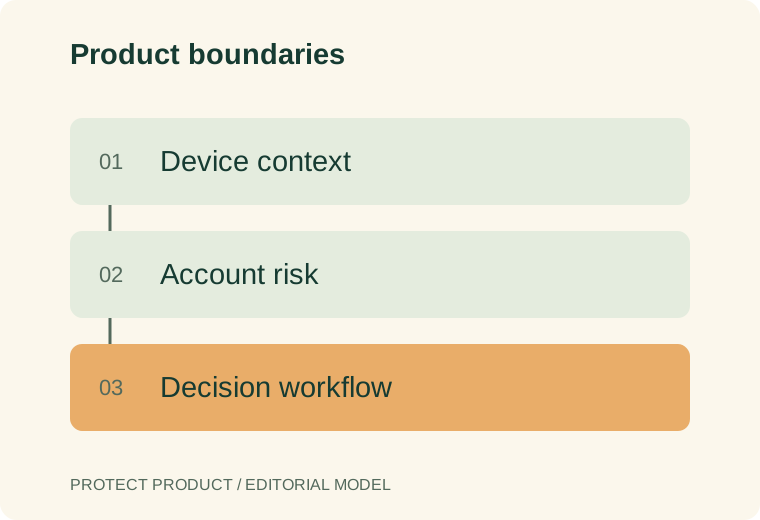
Choose one example: grant an introductory benefit, evaluate a changed login, review a payment or investigate related accounts. Write down the current evidence and the missing information that would improve that decision.
A hypothetical marketplace might already have payment decisions but lack context about repeated seller signups. Another business may have account linkage and need better native-device integrity evidence. They can both search for device intelligence while needing different purchases.
The marketplace guide and account takeover guide help define those different actions.
Compare evidence, interpretation and response
| Product layer | What it contributes | Question to ask |
|---|---|---|
| Collection | Supported client observations | Which fields are available on this platform? |
| Identity | A defined environment or device relationship | What exactly does the identifier represent? |
| Context | Network, integrity or other relevant fields | How are missing and uncertain results shown? |
| Interpretation | Named signals, events or assessments | What evidence and event history support the result? |
| Operations | Search, rules, review or exports | Who can investigate and correct a decision? |
A vendor may provide several layers. Confirm the plan and module boundary rather than reading the entire product portfolio as one included feature set.
Check web and native support separately
Ask for current SDK and browser support, field definitions and required permissions. A native app can have different observation opportunities and operating constraints from a browser. An identical product name does not establish identical output.
Include normal platform updates and restricted settings in the pilot. Keep unavailable fields visible. An app should not silently classify a missing observation as an evaluated low-risk device.
The mobile SDK checklist provides a more detailed evaluation for iOS and Android. Procurement questions about a particular region should also include the business’s reviewed data-handling and contractual requirements; do not infer compliance from a general platform label.
Build an evidence-based shortlist
The existing ShieldLabs review describes combined device/network context and account-level abuse detections. Fingerprint is relevant to an identity-input purchase. Incognia adds device/location-oriented scope that should be evaluated for the chosen client. Other tools in the review index address different parts of the workflow.
Compare the event model with your own account model. Does the service need signup, login and payment events? Can an analyst inspect the history behind a result? Which parts of the response are your team expected to build?
Avoid comparing vendor-specific scores as though they shared a scale. The IP score guide explains the same interpretation problem at the network layer.
Run the pilot around usable outcomes
Test returning customers, normal device changes, legitimate shared environments and controlled policy violations. Define expected treatment before observing results. Include an unavailable-service case and an incorrect relationship corrected through support.
Measure completion, reviewed loss outcomes, missing results and operating effort. A large field list or a stable demo value does not by itself establish better business protection.
Keep the collection scope and pricing unit in the final memo. A platform can be a good technical fit while requiring more events, modules or investigation work than the initial quote suggests. The parallel-test guide helps document that tradeoff consistently.
FAQ
Is device intelligence the same as device discovery?
Not in this guide. Fraud telemetry from customer interactions is a different purchase from enterprise asset discovery or device management.
Can one platform cover web and mobile?
Some offer several client integrations. Verify the current SDK, fields, permissions and plan for each platform separately.
Does a device-risk result prove an account owner’s identity?
No. It contributes context to a policy. Account authentication and identity proofing have their own evidence requirements.
Sources
Editorial basis: primary-source documentation and a practical evaluation framework. Examples are hypothetical unless explicitly identified otherwise. This article does not report an independent vendor benchmark.
For evaluation standards and corrections, see our methodology and contact page.