Read this article with AI
Copy the article text into your chosen tool to inspect its sources and trade-offs.
Separate the fingerprint families
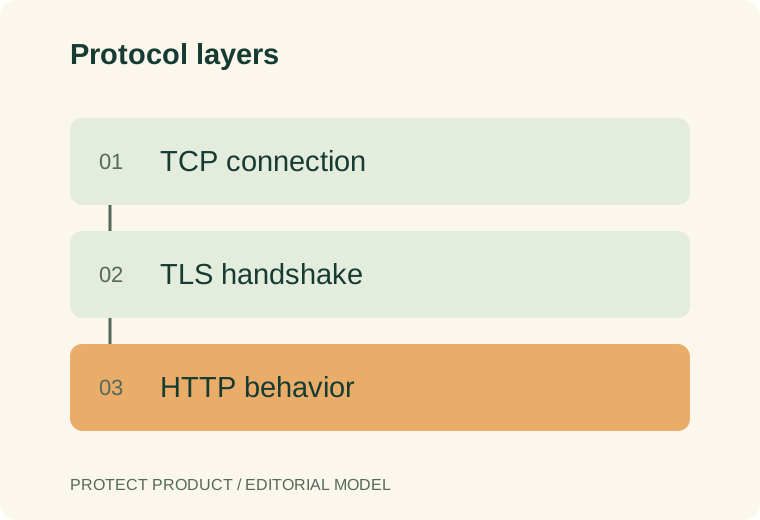
A TLS handshake, an HTTP request and a TCP connection expose different kinds of data. Names that belong to one family should not be used as shorthand for all of them.
The FoxIO JA4+ project documents a suite of related network fingerprinting methods. JA4 and JA4T are not interchangeable labels for the same input. Consult the current specification and implementation for the family you intend to measure.
| Layer | Kind of evidence | Interpretation boundary |
|---|---|---|
| TCP | Connection-level characteristics | Not an HTTP content or account verdict |
| TLS | How a client initiates a secure connection | Several clients can share a stack or pattern |
| HTTP | Request and protocol behavior | Headers and intermediaries affect context |
| Application | Account, action and business history | Requires its own authenticated associations |
Know where the observation is made
A reverse proxy or CDN can terminate a connection before the origin application receives the request. The original client connection and the downstream connection are not automatically the same evidence.
Ask which component produced the fingerprint and how it is attached to the application event. A field name alone does not show where the observation was made. Retain the relevant event time and provider context for investigation.
For a hypothetical service behind an edge platform, the origin may receive a request carrying approved context from that platform. The origin should follow the trusted integration contract instead of pretending it directly observed every part of the customer’s original connection.
Read vendor availability and missing-field rules
Cloudflare’s JA3/JA4 documentation describes product availability and cases where fields may be absent. That illustrates why an integration must handle the actual purchased service rather than assume a fingerprint always exists.
Keep non-applicable, unavailable and missing states explicit. An HTTP/2-related observation cannot describe a request using another protocol in exactly the same way. An encrypted or transformed boundary may also affect what the component can inspect.
Use the proxy API guide for a related input issue: determining the client address at the trusted forwarding boundary.
Use grouping without claiming a unique user
Two requests sharing a fingerprint may use the same software family, configuration or network path. That can be useful traffic context without proving that one person controls them. Ordinary browsers and applications can legitimately share characteristics.
Similarly, a changed fingerprint can reflect a software change or a different connection path. Do not automatically treat change as account takeover or a shared value as multi-accounting.
The device-provider guide explains how to ask what an identifier represents. Apply the same discipline to network-level fields: define the entity and the claim before deciding what action follows.
Build an authorized protocol-level evaluation
Use controlled clients and known deployment paths. Record protocol, client version, observation component and relevant transforms. The test should help explain whether a field is collected and associated correctly.
Then inspect the business policy using it. A traffic group may deserve a request limit, additional review or no change depending on its behavior and authority. A familiar fingerprint should not bypass account authorization, and an unfamiliar one should not automatically close an account.
For bot-related use, connect the results to the bot-control guide. For consistency between client and connection evidence, read the anti-detect evaluation article.
Choose generators and libraries from the actual project
If you need a JA4T generator or another implementation, start with the current official project’s supported tools, specifications and license terms. Do not substitute a random online value and assume it was computed from your traffic correctly.
Keep test traffic and captures within an authorized environment and the business’s approved data handling. A tool demonstration should verify the measurement path, not become instructions for disguising a client or evading a production service.
Document what the pilot established and what it did not. Protocol fingerprints can add useful context; the account and application decision still needs its own evidence and owner.
FAQ
Is JA4T the same as a TLS JA4 fingerprint?
No. Consult the official family definitions and implementation for the layer being measured.
Does one connection fingerprint identify a person?
No. It can group or characterize connection behavior. Account identity requires separate evidence.
Why can a fingerprint field be missing?
The protocol, observation path, purchased feature or collection settings may not support it. Follow the provider’s documented missing-field contract.
Sources
Editorial basis: primary-source documentation and a practical evaluation framework. Examples are hypothetical unless explicitly identified otherwise. This article does not report an independent vendor benchmark.
For evaluation standards and corrections, see our methodology and contact page.