Read this article with AI
Copy the article text into your chosen tool to inspect its sources and trade-offs.
Define what the returned label means
A vendor may return a raw observation, a named consistency signal or an interpreted event. Ask which of those it is and what supporting information is available. Avoid assuming that every product uses the same definition of an anti-detect environment.
Keep the observed fact separate from the conclusion. A field that was unavailable, a rendering change and a conflicting observation are different states. A useful review can inspect those differences instead of receiving only an unexplained badge.
The browser-techniques guide explains the observation families. This article focuses on consistency and fair interpretation, not on instructions for disguising a client.
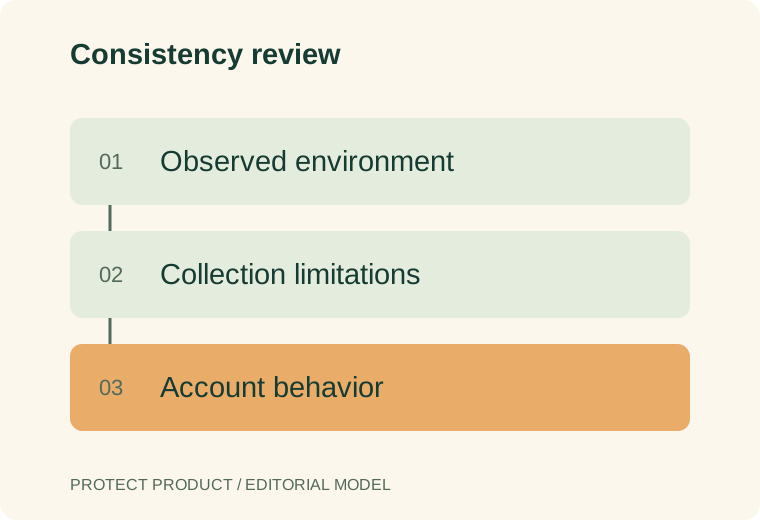
Inspect several kinds of consistency
| Area | Review question | Ordinary case to include |
|---|---|---|
| Reported environment | Do the reported capabilities fit the available observations? | Browser update or feature restriction |
| Rendering behavior | Is the result available and comparable? | Different graphics or privacy settings |
| Client and connection context | Which component observed each value? | Proxy, app wrapper or network change |
| Repeated events | What changed and when? | Legitimate account or device switching |
A difference can be real without being malicious. W3C’s fingerprinting guidance describes why browsers consider reducing or changing exposed information. Your policy should not mistake every privacy feature for proof of misconduct.
Keep headless automation and account abuse distinct
A headless client describes an execution context, not the full business outcome. Some automation is permitted, including tests, integrations and known crawlers. Conversely, a person operating an ordinary browser can make an ineligible benefit claim.
Use bot detection tools for the request-control purchase and multi-accounting detection for relationships among accounts. Their results can contribute to the same case without answering the same question.
For a hypothetical signup review, a consistency signal may increase uncertainty while the entitlement ledger shows whether the benefit was already claimed. Keep both observations with the decision rather than treating the browser label as the eligibility rule.
Verify the observation path
Confirm the collector version, supported platform and server association. A partial integration or stale result can create misleading comparisons. Record the event reference and which action used it.
If connection fingerprints are included, check where the connection terminates and which component can observe the original client. The TLS and HTTP fingerprinting article explains that network-layer evidence has its own scope.
An unavailable signal should remain unavailable. Do not replace it with an apparently normal value simply to complete the schema. Operations needs to distinguish an evaluated result from a data gap.
Use authorized test cases
Prepare controlled normal environments, supported privacy settings, software changes and deliberately inconsistent test conditions where authorized. Record expected treatment before running the evaluation. Do not use a vendor demonstration as a recipe for evading another service’s controls.
Inspect both the detector result and the application response. The signal may be functioning as documented while the app’s rule is too broad. A temporary review or verification step can have a different customer cost from permanent account closure.
Ask the vendor to show how an incorrect relationship or result is handled. Support should have a decision reference and a safe next step without needing unrestricted raw evidence or customer credentials.
Report the limits of the evaluation
Keep client versions, collection coverage, observation window and label definitions with the results. Separate missing observations, changed results and incorrect restrictions. Do not summarize a narrow test as universal detection of every privacy or anti-detect tool.
Compare confirmed policy outcomes and legitimate completion. The false-positive guide explains how to state the denominator and avoid confusing a suspicious event with confirmed abuse.
Choose a limited rollout and a policy owner. The evidence should improve a defined business decision rather than becoming an accusation that cannot be reviewed.
FAQ
Does an inconsistent browser fingerprint prove abuse?
No. Software changes, restrictive settings and collection issues can affect observations. Evaluate the specific inconsistency and business context.
Is a headless browser always unwanted?
No. Determine whether the client and action are permitted. Testing, integrations and known automated access can be legitimate.
Does this article explain how to avoid detection?
No. It covers authorized evaluation, signal interpretation and proportionate application controls.
Sources
Editorial basis: primary-source documentation and a practical evaluation framework. Examples are hypothetical unless explicitly identified otherwise. This article does not report an independent vendor benchmark.
For evaluation standards and corrections, see our methodology and contact page.