Read this article with AI
Copy the article text into your chosen tool to inspect its sources and trade-offs.
Define what an alert actually establishes
An alert may concern an email, a password in a known breach corpus, a domain or another ID. Start with three questions:
- What information does the alert concern?
- When did the source report it?
- What did the provider actually verify?
A past exposure and a current unauthorized login are different findings.
No alert does not mean no exposure. A provider can only check the sources it covers and the data it has received. Review your own sign-in records and sensitive account changes too.
The account takeover signals guide explains that live account context. Exposure data is one input to remediation, not a replacement for it.
Avoid turning the check into another disclosure
Use an approved integration method and send only the information required for that check. Never paste a customer’s raw password into an arbitrary website or log it in a support case. Keep credentials out of ordinary analytics events.
Have I Been Pwned documents its Pwned Passwords API. Its range lookup sends a five-character hash prefix and returns matching suffixes for local comparison. Follow the current protocol and your approved security design. A lookup protocol is not a password-storage design, and it does not justify sending raw passwords to an unrelated service.
Separate who can configure the monitoring integration from who can handle an alert. Operations may need a reference and remediation status without unrestricted access to sensitive source material.
Connect the alert to an owned account safely
| Record | Useful information | What it does not establish alone |
|---|---|---|
| Exposure observation | Affected identifier, source context and observation date | Current session control |
| Sign-in event | Authentication result, timing and account reference | The complete history of credential exposure |
| Session event | Sensitive changes and current permissions | Legal identity of the person operating it |
| Remediation case | Verified account association, response and resolution | A universal conclusion about all related accounts |
Verify the match, then link the alert to an internal account ID. Addresses can change owners or mean different things in separate systems. Record why the match is valid. An address submitted through a public form is not proof that its submitter controls the account.
For a hypothetical SaaS business, an alert about a customer’s address could prompt review of recent sign-ins and the registered recovery process. It should not automatically expose that customer’s private account state to someone submitting the same address through a public form.
Choose a remediation that fits the evidence
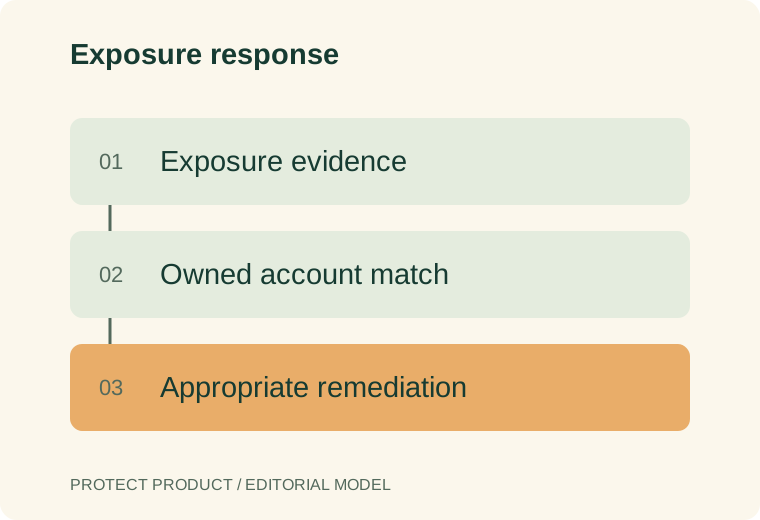
Choose the response from the evidence. You might notify a verified account owner, use the approved password-change flow, request another check or investigate a recent account change. Assign the decision to an owner.
Avoid blanket measures that can be triggered repeatedly by an unauthenticated outsider. A public recovery process must not become a convenient way to deny service to an account owner. The OWASP forgot-password guidance provides useful foundations for designing that surrounding flow.
An alert indicating possible credential reuse can also inform the credential stuffing prevention plan. Keep the distinction between the exposed information and observed attempts explicit in the incident memo.
Evaluate a monitoring vendor on usable evidence
Ask about source coverage, update timing, alert semantics, account association, investigation access and data handling. Request examples of an ambiguous alert and a corrected record. An impressive feed volume is less useful if operations cannot determine which customer or action it concerns.
If alerts go to a SIEM or security event system, define who receives them and which fields staff need. Deduplicate events. Decide when to close or reopen a case. A feed that repeatedly reopens the same resolved case consumes review time without showing a new threat.
Measure resolution and exposure of the workflow itself
Track valid alerts, unresolved matches, response time and completed customer recovery. Review false matches and support cases alongside confirmed compromise. Keep a history of source changes so the team can explain a sudden alert spike.
Practice a provider outage and a delayed alert. The normal authentication system should still have a documented operating policy. Monitoring can improve awareness, but an unavailable exposure feed should not silently redefine every account as either safe or compromised.
Use the fraud dashboard guide to design an alert view that separates observations, decisions and confirmed outcomes.
FAQ
Does an exposed email address prove account takeover?
No. It may justify a relevant investigation, but the current account and session need their own evidence.
Can a business monitor exposures before a login occurs?
Some services provide exposure observations independently of a live login. Confirm their coverage and timing; the observation is not itself a live authentication verdict.
Should raw passwords be stored for later checking?
Do not build an exposure-monitoring process around collecting raw customer passwords. Follow the approved authentication and checking design for the service you use.
Sources
Editorial basis: primary-source documentation and a practical evaluation framework. Examples are hypothetical unless explicitly identified otherwise. This article does not report an independent vendor benchmark.
For evaluation standards and corrections, see our methodology and contact page.