Read this article with AI
Copy the article text into your chosen tool to inspect its sources and trade-offs.
Connect the term to the system being protected
John Douceur’s original Sybil attack paper studies how one entity presenting multiple identities can undermine a peer-to-peer system. Its model is a useful conceptual source, not a tested fraud rate for a modern airdrop or SaaS product.
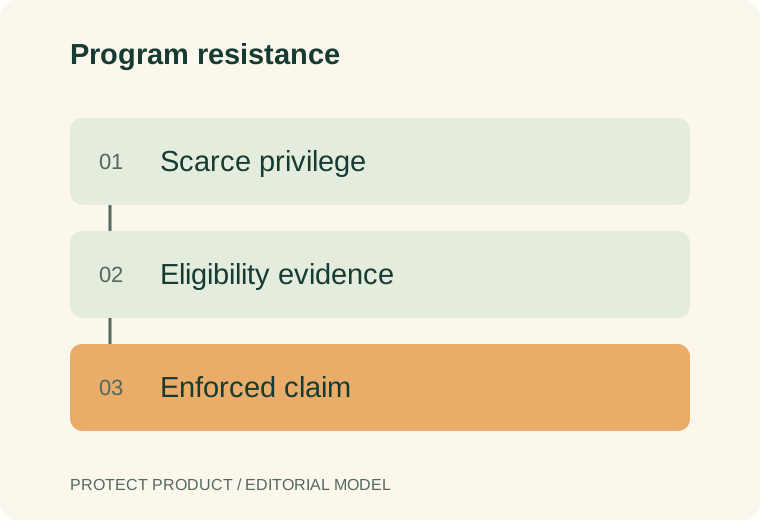
For your service, name the scarce privilege: votes, invitations, rewards, trial compute or access. A person operating several accounts is not necessarily abusive unless it violates the system’s rules or trust assumptions. Make those rules clear before assigning an enforcement label.
Define the entity entitled to a claim
A program may allocate benefits per account, person, organization or verified relationship. These are different units. A wallet address is an address in the relevant system; it does not independently establish a distinct person.
| Policy unit | Question to resolve | Limitation |
|---|---|---|
| Account | Has this account claimed already? | One operator may control several |
| Device environment | Was a related environment observed? | Devices can be shared or replaced |
| Organization | Is this a distinct eligible business? | Requires appropriate organization evidence |
| Verified person | What supports the identity claim? | Needs a suitable proofing process |
| Reputation | What prior behavior earns privilege? | History does not prove independent control |
If the policy requires identity proofing, choose that process deliberately. Synthetic identity fraud explains why device risk and proofing are separate disciplines.
Compare resistance mechanisms by trade-off
Rate limits constrain activity over time. Resource requirements change the cost of participation. Reputation restricts privileges until an account has relevant history. Identity checks establish a defined claim using selected evidence. None should be represented as an interchangeable universal proof of uniqueness.
Evaluate access cost and legitimate exclusions alongside abuse resistance. A rule that is easy for a well-funded operator to satisfy may still burden an ordinary user. The appropriate design depends on the program’s stakes and intended participants.
Keep these as defensive evaluation questions. This article does not provide a guide to farming identities or circumventing a reward system.
Review relationship evidence before denying benefits
Use account, event and approved device or network relationships to prioritize cases. Preserve the relationship type and collection uncertainty. A shared connection among students or family members needs different treatment from stronger evidence of coordinated repeated claims.
In a hypothetical community, several members join through a public workshop using shared computers. A device match is expected. The review should examine eligibility and control under the community’s actual policy rather than silently convert a device into a person.
The multi-accounting guide covers relationship evaluation. Referral fraud detection covers incentive loops between related accounts.
Enforce rewards and privileges on the server
Keep a record of claim eligibility, reservation, fulfillment and reversal. Check the relevant rule when the scarce benefit is released, not only when the account is created. Repeated requests should not create additional claims for the same authorized operation.
Separate a risk suggestion from an enforcement action. A reviewer may need to resolve uncertain cases before a payout. If blockchain execution is involved, evaluate the smart-contract and off-chain boundaries with the appropriate engineering owners; a browser SDK cannot change those guarantees by itself.
Measure resistance and participation together
Track confirmed coordinated misuse, eligible claims completed, appeals, unresolved cases and operating effort. Do not count every related-account alert as a separate prevented Sybil identity.
Start with one benefit and an explicit eligibility rule. Test known authorized cases, shared environments and missing evidence. A useful pilot should show how the rule limits repeated influence while allowing intended participants to complete the program.
FAQ
Is a Sybil attack the same as a fake email account?
Not necessarily. The concern is one entity gaining influence through multiple identities in the protected system. An email address alone does not define that influence.
Does one wallet equal one person?
No. The system needs separate evidence if its policy depends on a distinct person rather than an address.
Can device intelligence guarantee Sybil resistance?
No. It can contribute relationship evidence, but the system’s trust, eligibility and enforcement design determine the broader resistance.
Sources
Editorial basis: primary-source documentation and a practical evaluation framework. Examples are hypothetical unless explicitly identified otherwise. This article does not report an independent vendor benchmark.
For evaluation standards and corrections, see our methodology and contact page.