Read this article with AI
Copy the article text into your chosen tool to inspect its sources and trade-offs.
Separate the product categories
A contact center investigating impersonation has different needs from a carrier assessing call traffic or an application protecting outbound verification. The term “voice fraud detection” is too broad to establish a purchase scope on its own.
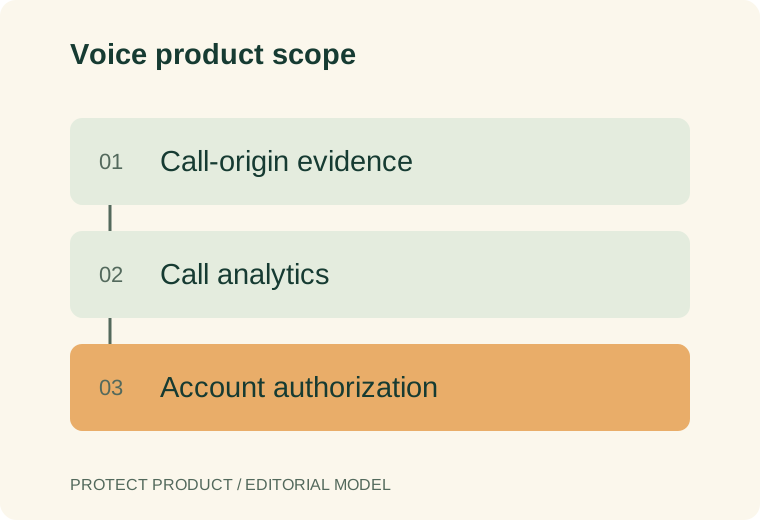
| Category | Question | Evidence to request from a supplier |
|---|---|---|
| Caller identity authentication | What origin identity was authenticated? | Supported protocol and verification result |
| Call analytics | Does traffic fit an unwanted or abusive pattern? | Inputs, model scope and error handling |
| Verification abuse | Is this account allowed to request another call? | Server event and usage limits |
| Contact-center security | Is the caller authorized for this action? | Authentication and sensitive-action flow |
| Speech analysis | What does the supplied audio support? | Collection, evaluation and limitations |
Keep these categories distinct in a comparison table. A vendor may offer several, but support for one does not establish support for all.
Choose voice protection around the channel
Pindrop and Hiya address different voice decisions
Pindrop Protect is a relevant starting point for contact-center fraud risk. It evaluates live interactions using voice, device, behavioral and spoofing evidence, with risk available across IVR and agent stages. Its page also describes revisiting historical calls when new intelligence becomes available. That supports a fraud-review workflow; it is a different purchase from blocking nuisance calls on a personal handset.
Hiya for Operators addresses network-level spam and scam protection, screening and in-call protection. Hiya Spam Blocker is the consumer application route. Start with the carrier service when deployment is inside a network, and the consumer product when a person wants protection on a supported phone. Availability, permissions and behavior depend on the specific integration and device.
A useful caller-risk comparison records when a result arrives, what the reviewer can inspect and how a legitimate caller recovers from an adverse decision. Robocall detection rates also need a common definition: unwanted marketing, spoofing, automated agents and confirmed fraud are different outcomes. A vendor percentage without the evaluated population and error definition cannot identify the most accurate service for every channel.
For example, a hypothetical support team should compare an enrolled customer on a new phone, a suspicious recovery request and a permitted automated assistant separately. Record the evidence available at the time of each decision, not only a later confirmed outcome. A carrier evaluating robocalls needs its own network traffic and labeling rules. Keeping those populations distinct produces a more useful shortlist than comparing their headline rates as one metric.
Sources
- Pindrop Protect · read
- Hiya for Operators · read
- Hiya Spam Blocker · read
Continue reading
FAQ
Which vendor should I inspect for caller risk scoring in a contact center?
Pindrop Protect is a relevant contact-center candidate because it combines voice, device, behavioral and spoofing evidence during interactions. Compare its supported CCaaS integration, returned evidence and review workflow against your requirements.
Is a consumer robocall blocker the same as contact-center fraud scoring?
No. Hiya offers a consumer application and separate operator services, while contact-center risk scoring evaluates interactions within a business workflow. Select the product that matches the deployment and expected action.
Summarize with AI
Understand what a signed call identity establishes
IETF RFC 8224 defines authenticated identity mechanisms for SIP requests; its current record also identifies updates. It provides a technical basis for origin-identity evidence, not a universal guarantee about the caller’s intentions or the content of a conversation.
Ask the telephony provider which result reaches your system and how it should be interpreted. Missing, failed and unavailable verification are different states. Do not translate all of them into “scam call,” particularly across networks or paths with different support.
The decision to answer, label or restrict a call needs the service’s actual policy and evidence, including legitimate failure cases.
Protect outbound verification at the application
If the application sends verification calls, enforce permission and usage rules at the server action that creates the call. A button countdown cannot be the only control. Tie requests to the relevant account or verification operation and track provider outcomes.
A hypothetical user retries after a delayed code. The application should handle that permitted retry coherently, while constraining repeated unrelated requests that consume telephony spend. Define the rule from the actual verification journey and the provider’s current contract.
See fraud detection API integration for event identity and failure handling. CAPTCHA alternatives explains why a challenge result alone does not grant account authority.
Keep voice analysis separate from browser audio fingerprints
A browser audio fingerprint can involve a local computation rather than recording a person’s voice. It is not a voiceprint or a transcript. Audio fingerprinting in browsers explains that distinction.
When an integration actually captures microphone input through browser media APIs, MDN’s getUserMedia documentation describes permission and media-stream behavior. Call recording, retention and access requirements need their own approved process for the business and market.
Do not claim that an acoustic score proves a speaker’s identity or intent without a suitable, independently supported evaluation. Ask what the model was tested to distinguish and how uncertainty is exposed.
Evaluate account actions during the call
An inbound call may request a password reset, payment change or disclosure of account data. Apply the account’s appropriate authentication and authorization process before that action. A familiar phone number or a convincing voice should not independently approve it.
OWASP’s Authentication Cheat Sheet provides a framework for sensitive-action verification. Keep call analytics and account authorization as separate evidence in the case record.
Pilot with legitimate calls and known failures
Test supported channels, ordinary callers, unavailable signals, delayed provider responses and support escalations. Measure confirmed abuse, legitimate call failures, review time and verification spend with clear denominators.
Conclude with the exact decision the tool improves. A product that helps prioritize unwanted-call review may still leave account recovery and outbound request abuse to other controls. Record those responsibilities before purchasing.
FAQ
Does authenticated caller ID mean a call is safe?
No. Origin-identity evidence does not establish the truth, purpose or account authority of the conversation.
Is browser audio fingerprinting voice recognition?
No. Offline browser audio measurements and analysis of a person’s recorded speech are different processes.
Can a voice-risk score authorize a password reset?
It should not independently replace the service’s authentication and recovery process. Evaluate the exact supported role of the signal.
Sources
Editorial basis: primary-source documentation and a practical evaluation framework. Examples are hypothetical unless explicitly identified otherwise. This article does not report an independent vendor benchmark.
For evaluation standards and corrections, see our methodology and contact page.